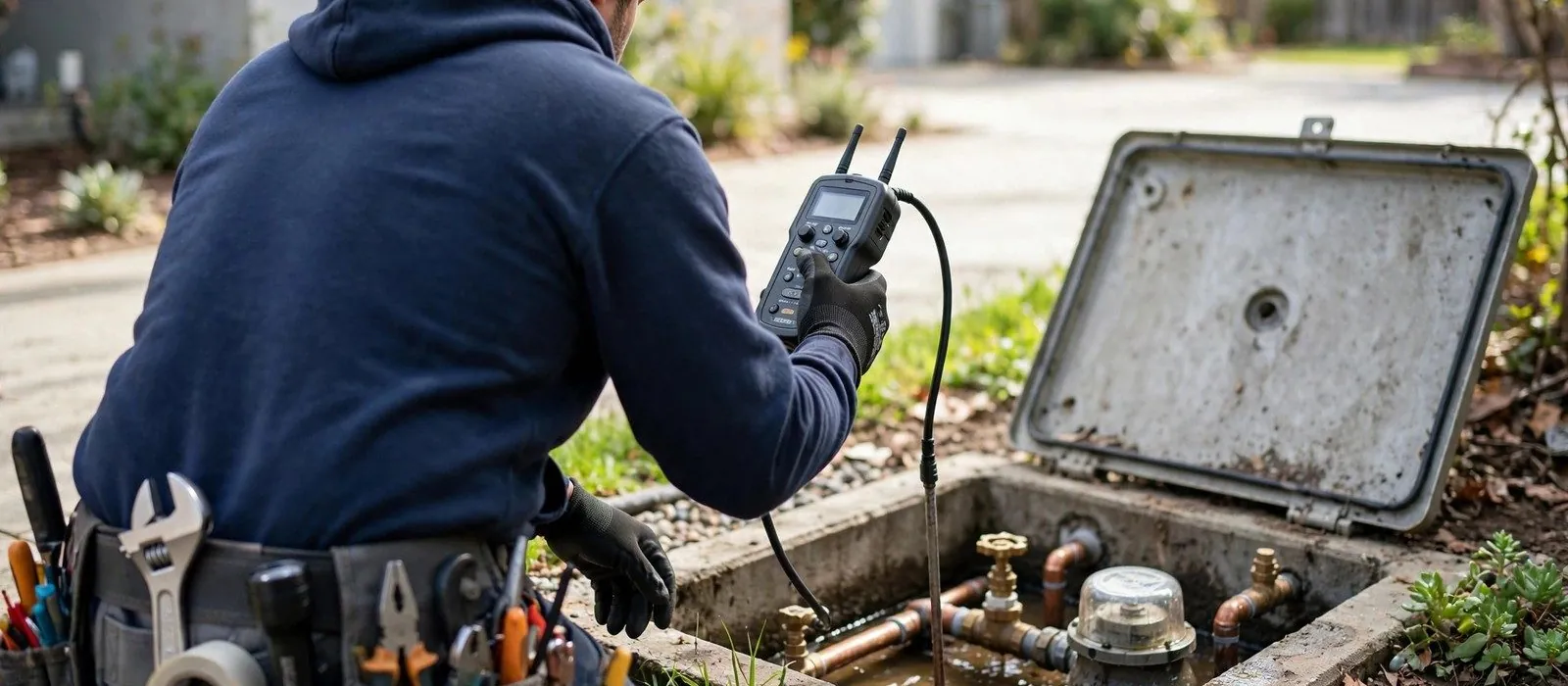
The meter test: confirm a leak in ten minutes
You need a flashlight, a pen and a phone. Skip showers, laundry and dishwasher cycles while you test.
- 1
Turn off everything that uses water
Close taps, stop the washer and dishwasher, and turn off the ice maker if you can. Make sure no one flushes.
- 2
Find the meter box
It is usually at the front of the property near the street, under a lid. Lift it with a screwdriver and watch for insects.
- 3
Look at the leak indicator
Many meters have a small triangle, star or dial that spins when any water flows. If it turns with everything off, there is flow.
- 4
Write down the reading
Note the digits on the register, or take a photo, then wait 30 minutes without using water.
- 5
Read it again
Any change in the digits points to a leak. A small change over a long wait can still mean a slow leak.
An ice maker or a water softener that recharges can move the dial briefly. If you see it move once and stop, repeat the test.
What the meter result tells you
| Result | Meaning | Next step |
|---|---|---|
| Indicator still, digits unchanged | No leak found in that window | Check the bill against usage, then check irrigation |
| Indicator spins slowly | A small leak, often a toilet or drip | Run the toilet dye test |
| Indicator spins fast | A larger leak, possibly underground | Close the house shutoff and see if it stops |
| Stops after the house shutoff is closed | Leak is inside the house | Check fixtures, the water heater and appliance lines |
| Keeps spinning with the house shutoff closed | Leak is between the meter and the house | Call a plumber for a line check |
The house shutoff test is the key split. It tells you whether the leak is inside your walls or out in the yard.
Meter work in Wellington and what the village says about high usage
The Village of Wellington began a water meter replacement program in 2026. When a crew changes your meter, service is interrupted for about 15 to 30 minutes, and the village suggests running your taps for 2 to 3 minutes afterward to flush the lines.
Its billing FAQ also names leaky fixtures and irrigation as the most common reasons for high usage. So if your reading jumps after a meter change, do the shutoff test above first, because a new meter does not make a leak and an old leak does not go away.
Meter still running?
Call (561) 448-8545 with your two meter readings in hand.
Toilet dye test and other quick fixture checks
Most hidden leaks in a house are small and silent, and the toilet is the first suspect.
- Toilet dye testAdd a few drops of food coloring to every tank, leave the toilets alone for a quarter hour, and see whether the bowl water has tinted.
- Faucets and showerheadsA slow drip wastes more than you would think. Look under sinks for damp cabinets.
- Water heaterCheck the floor and pan around the tank and its relief valve pipe.
- Refrigerator and ice maker linePull the fridge out and look for moisture behind it.
- Washer hosesBraided hoses wear at the connection. Look for rust or a damp wall.
- Outdoor spigotsA hose bib that drips inside the wall can go unseen for months.
Irrigation, pools and other outside suspects
If the house passes the test, look outside.
Sprinkler zones
A stuck valve or cracked head can run all night. Walk the yard for soggy or unusually green patches.
Underground line
Wet ground near the meter, or a lawn spot that stays green and squishy, points to a pipe leak.
Pool or spa fill line
An auto-fill valve that sticks open can add hundreds of gallons without notice.
Meter box itself
Water pooling inside the meter box can mean a leaking fitting at the meter. Your utility handles the meter and can tell you where its side ends.
How to read a high water bill
Compare your gallons this cycle to the same month last year, not just last month. Guests, a new pool fill, or an irrigation schedule change can all raise usage. If nothing changed and the number is up, the meter test comes next.
Remember that bills reflect past use. A leak that started three weeks ago will not show fully until the next cycle, so check early rather than waiting. Do not run water just to test a theory, since extra flow adds to the bill.
Handle it yourself or call a plumber?
A simple fix at home
- A toilet flapper that leaks.
- A dripping faucet washer or cartridge.
- A sprinkler head or zone valve.
- A loose washer hose.
Call a licensed plumber
- The meter spins with the house shutoff closed.
- You see wet spots in the lawn, a damp slab or a warm floor.
- Water is leaking inside a wall or above a ceiling.
- You cannot find the leak after running the tests.
When to call a plumber about a hidden leak
If the tests point to a leak you cannot see, our leak detection team uses listening gear and pressure checks to locate it without tearing open walls. When the trouble sits between the meter and the house, our water line repair service covers the fix.
If water is flooding a room or a ceiling is sagging, shut off the main and phone (561) 448-8545 any hour. A house close to Royal Palm Beach may still be in range, so check the service area list.
Questions homeowners ask
Look for a moving dial or triangle on the meter face, or compare the digits before and after a 30 minute wait with every tap off.
Yes. Pipes in slabs, walls and underground often leak without surface signs for a while. The meter is the best early clue.
The Village of Wellington began a meter replacement program in 2026. Service is out for about 15 to 30 minutes, and the village suggests flushing the lines for 2 to 3 minutes after. Take a photo of your reading before and after if you can.
It is a common one, and the village lists irrigation among the leading causes of high usage. Run each zone and watch for geysers or soggy ground.
The price depends on access, pipe layout and how many tests are needed. A technician gives you a clear price before work starts.
Coverage often hinges on whether the damage was sudden or long-running, so read your policy and ask your agent.
Still have a question? Call (561) 448-8545