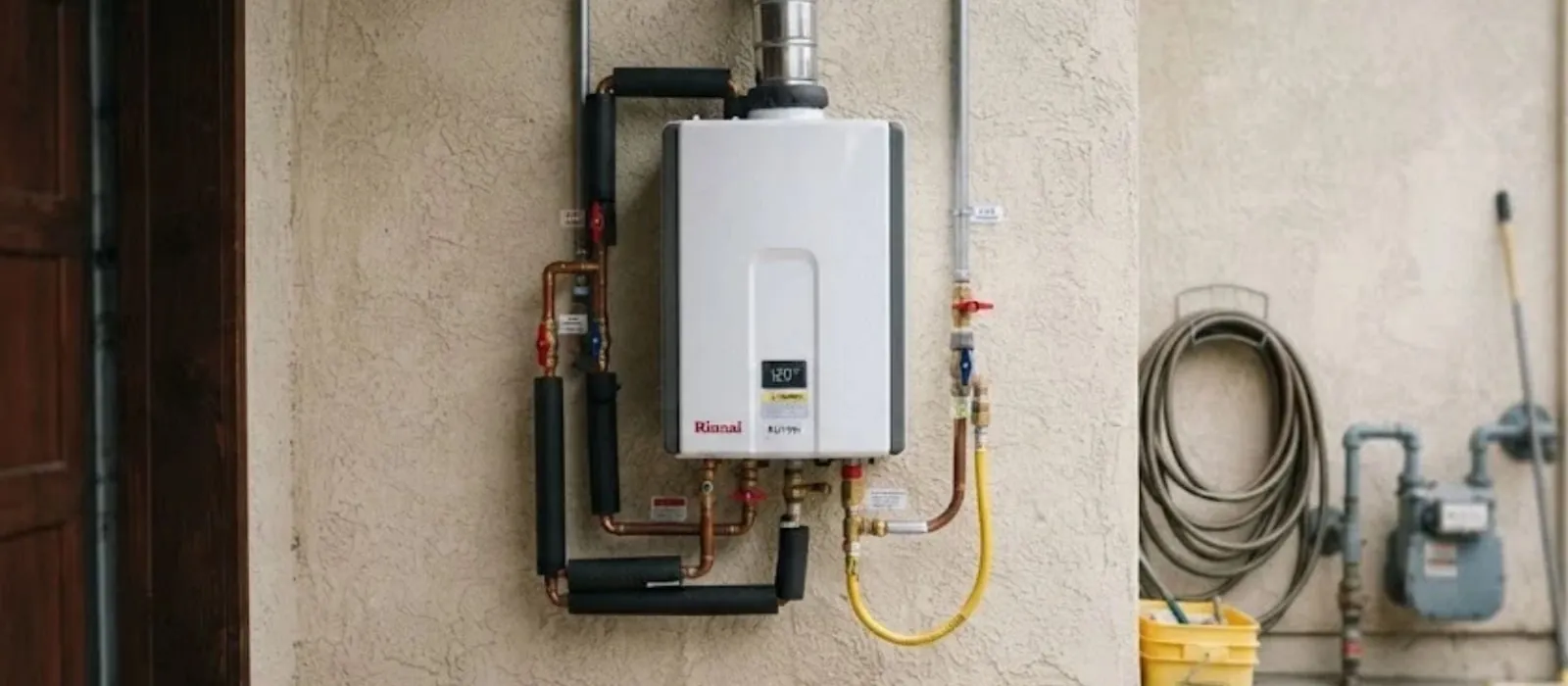
Tankless or tank: how the two really differ
Neither type wins everywhere. This is the comparison we walk through with homeowners who are on the fence.
Traditional tank
- Lower purchase and install cost
- Stored hot water covers a power or gas hiccup for a short time
- Simple parts and widely known repairs
- Takes up floor space
- Runs out when a large family uses all the hot water at once
- Standby heat loss while the tank sits full
Tankless unit
- Hot water on demand with no storage wait
- Wall-mounted, so it frees floor space
- No tank wall to corrode through
- Higher upfront cost and more complex install
- Needs correct gas line, venting or electrical capacity
- Needs periodic flushing to stay efficient
If you are replacing a failed tank and choosing between the two, our water heater installation page covers the planning steps.
Flushing and descaling a tankless heater
Inside a tankless unit, water passes through a narrow heat exchanger. Minerals in the water bake onto those surfaces as scale, which narrows the passage, raises the temperature the unit needs to work and triggers error codes. A flush with a descaling solution runs through the exchanger and dissolves that layer.
A typical service connects a small pump and two hoses to the isolation valves, circulates the solution for a set time, rinses clean, and cleans the inlet screen. Most manufacturers recommend doing it on a schedule, often once a year, and the manual for your model sets the exact interval.
How often you really need it depends on your water. The Village of Wellington's lime softening plant reduces hardness, but its annual water quality report does not list a hardness number. So a test of your own tap, or a question to Wellington Utilities, tells you more than a guess.
Skipping flushes does not cause a sudden failure. It wears the unit down slowly, until you notice lukewarm showers, a cold sandwich effect, or a code that will not clear.
Signs a tankless unit is overdue for service
Error codes returning
Flow, ignition or temperature codes that clear and come back often trace to scale or a clogged inlet screen.
Water runs warm, not hot
A scaled heat exchanger cannot transfer heat well. Showers feel weaker even though the unit fires.
Kettle-like rumbling
Noise from the unit during use suggests mineral buildup or restricted flow.
Cold gap between hot bursts
Short draws sometimes leave a cold slug. Settings, flow rate or buildup could all be involved.
Higher gas or power use
The unit works harder to hit the set temperature when the exchanger is coated.
Tankless unit acting up?
Read the display, note the code and a plumber can say whether a flush will do.
Chloramines and your water system
Wellington Utilities normally disinfects with chloramines and periodically switches to free chlorine on a temporary basis as maintenance. Chloramine can shorten the life of some rubber seals and gaskets.
The Village also treats the water through lime softening and membrane filtration, and the treatment mix is changing as it phases out lime softening. That is one more reason a tankless service schedule should follow your own tap test and your unit's manual, not a fixed rule.
Tankless installs follow the manufacturer's instructions and local requirements, and gas units need correct gas pipe sizing and venting.
How a tankless installation proceeds
Replacing a tank with a tankless unit is a bigger job than a straight swap.
- 1
Check gas, power and venting
Tankless units pull a lot of fuel or current in a short burst. We confirm the supply and the vent path can handle it.
- 2
Size the unit
We match flow rate to how many fixtures run at once, not only to home size.
- 3
Mount and connect
The unit goes on the wall. Water lines, isolation valves and the gas or electrical connection are made.
- 4
Set up for service
Isolation valves make later flushing simple. We show you where they are.
- 5
Test and walk through
We run hot water at several fixtures and check for leaks and code-free operation.
Gas work follows the rule that matters most: if you ever smell gas, leave the building and call the gas utility or 911 before you call us.
Tankless water heater cost drivers
A tankless install costs more than a tank swap because of the extra work around the unit. A flush costs far less than a repair.
Tankless warranties often depend on routine flushing. Keep records of each service. Insurance does not cover wear, but sudden water damage may be covered, so check your policy.
Before you buy or service a tankless unit
- Read the manual. The flush interval and the descaling product are set by the maker.
- Find the isolation valves. Without them, flushing requires extra plumbing.
- Clean the inlet screen. It is a small filter that catches debris and clogs often.
- Know your fuel line. Gas size and pressure matter for tankless more than for tanks.
- Test your tap. Check mineral content before choosing a flush schedule. Pairing a unit with a water softener or filter is worth discussing.
When a tankless unit needs more than a flush
If a flushed unit still shows the same code, the cause is usually a failed sensor, a dirty burner, a bad igniter or a vent problem. Those are repairs, not maintenance, and each has its own price.
Leaks around the unit's bottom connections are worth a quick call. A weeping union is a small fix, but left alone it can run down the wall. For the hidden kind, try leak detection.
Questions homeowners ask
Many makers say once a year, but your manual sets the interval for your model. Homes with more mineral content may need it more often, so test your tap or ask Wellington Utilities.
It depends on household size, fuel and budget. Tankless gives endless hot water and saves space, but costs more upfront. We lay out both options before you commit.
If isolation valves are installed and you follow the manual, some owners do. A plumber also checks the inlet screen, burner and venting during the visit.
Makers often claim a longer lifespan than for tanks, but the real number depends on use, maintenance and your water. Regular flushing helps.
We diagnose and repair common tankless models. Send us the make and error code when you call so we can bring the right parts.
Codes vary by brand. Many point to flow, ignition or temperature faults. Scale and a clogged screen cause a lot of them.
Yes, our Royal Palm Beach coverage page lists the ZIP codes. The 24/7 line is open day and night.
Still have a question? Call (561) 448-8545