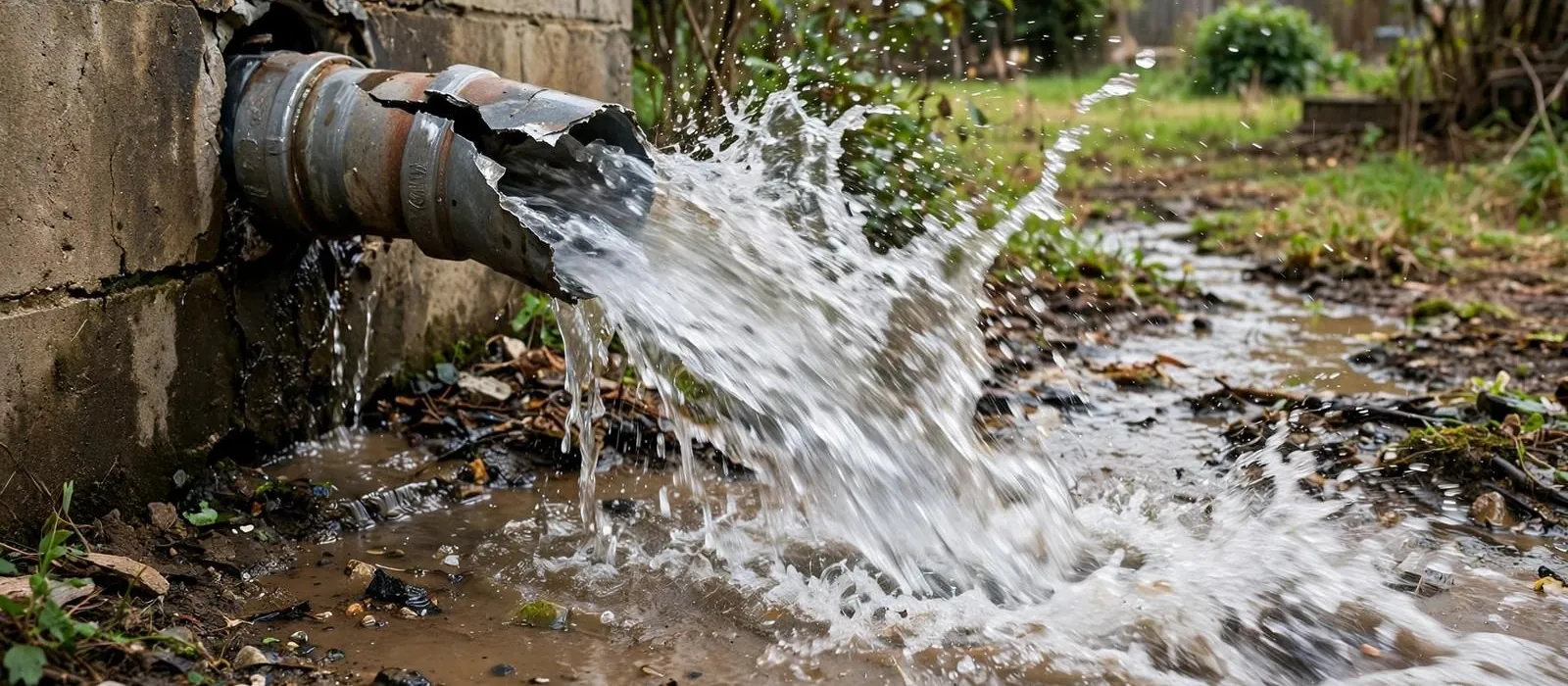
What to do the minute a pipe lets go
Speed matters more than neatness. Work through these in order.
- 1
Close the main valve
Turn a round handle clockwise until it stops, or turn a lever a quarter turn so it sits across the pipe. Most homes have it near the street side of the house or at the meter, and a second shutoff may sit at the water heater.
- 2
Open the lowest tap
Draining the lines relieves pressure and stops water from pushing out of the break.
- 3
Kill power where it is wet
Switch off breakers for affected rooms. Do not stand in water to reach the panel.
- 4
Switch off the water heater
If water is draining out of the system, turn off the breaker or gas control so the heater does not run dry.
- 5
Call and describe the damage
Tell us where the water is, how fast it moves and whether the main closed. That helps us arrive with the right pipe and fittings.
Cracked and split pipes
Pipes rarely fail without warning. A pinhole weeps for months, then a fitting gives way or a split opens along a seam. Cracks come from age, vibration, a hammering valve, a bad joint or a previous repair that was never pressure tested.
The first job is stopping the water. The second is deciding how much of the line to replace. A small section can often be cut out and swapped with a coupling. If the pipe is brittle or pitted along its length, a longer replacement is the honest answer.
We check the pipe on both sides of the break before closing it up. A fresh patch next to tired pipe tends to fail at the next weak point.
Water still spreading?
Spray, drip or stain: call (561) 448-8545 and say where the water is.
A broken or burst supply valve
Angle stops under sinks and toilets, and the shutoff valves at appliances, are small parts that cause big floods. A seized valve cracks when forced. A corroded stem leaks until the packing blows out. A braided supply line can burst at the crimp.
Replacing a valve is often quick, but only if the main is closed and the line can be cut. For fixtures with their own leak, our faucet repair team handles the valve and the trim together.
Copper pipe repair
Copper is durable but not immortal. Pinholes, split sweated joints and dents from freezing or impact are the common failures. A repair uses a coupling or fresh solder, and the joint must be dry before the flame goes on.
If pinholes show up in more than one spot, the pipe is wearing from the inside. That is the moment to ask about a section replacement or repiping rather than another patch.
Pipe failure and what repair usually involves
A quick guide to what the technician is likely to look at, depending on where the water is coming from.
| Where water appears | Likely failure | Typical repair | Can wait until morning? |
|---|---|---|---|
| Spraying from a wall or ceiling | Split pipe or blown fitting | Shut off, open the wall, replace the section | No, call now |
| Under a sink or behind a toilet | Supply line or angle stop | Close the local valve, replace the part | Usually yes if the valve holds |
| Yard or driveway, wet and soft | Buried line break | See water line repair | No if pressure is lost |
| Slow stain on a ceiling | Pinhole or loose joint | Locate, then repair | Depends, close the main if it grows |
If you are not sure, call. A dispatcher can ask the right questions faster than guessing.
Storm season and a house with no water
The Atlantic hurricane season runs from June 1 to November 30, and the Village of Wellington advises keeping supplies for at least 72 hours. Know where your main shutoff is before a storm, because a pipe that fails during an outage is harder to spot.
After a main break or a service disruption, the village guidance on boil water is typically 48 hours at a rolling boil for one minute. If you are not sure whether to boil, ask Wellington Utilities. For work after a storm, the village also advises using only licensed and insured contractors.
Pipe repairs fall under the Florida Building Code, Plumbing volume, which is based on the International Plumbing Code (IPC). Permit needs vary by job, so ask the Building Division or a licensed plumber whether a burst pipe repair needs one.
A stopgap versus a proper repair
Temporary measures hold for hours, not weeks.
Stopgap you can do
- Close the main and drain the lines
- Wrap a rubber and clamp patch over a pinhole
- Place buckets and towels to catch drips
- Move valuables and lift rugs
What the plumber does
- Cuts out the damaged section
- Installs matching pipe and fittings
- Pressure tests the repair
- Checks the rest of the line for weak spots
- Gives you a clear price before work starts
A clamp on a split pipe can hide a bigger problem. Treat any stopgap as a bridge to the real fix.
Before we arrive
Clear the way
Open a path to the shutoff valve, the water heater and the damaged wall or ceiling.
Dry what you can
Wet carpet and drywall grow mold in a day or two in humid weather. Fans help while you wait.
Take photos
Pictures of the burst, the wet areas and the closed valve help with insurance.
What changes the price of a burst pipe repair
Two bursts can look alike and cost very differently. We give a clear price before work starts, after we have seen the damage.
Insurance often responds to sudden burst damage, while gradual leaks and wear are commonly excluded. Policies differ, so check yours and call your agent early.
Questions homeowners ask
Yes. The line is open 24 hours a day, every day, and a dispatcher answers at any hour. Same-day appointments are offered when available.
Shut off the main valve while you wait.
It is often near the front hose bib, at the water meter or on a garage wall closest to the street. Look for a round handle or a lever. A technician can mark it for next time.
Usually yes, after the technician pressure tests the repair. Run taps for a few minutes to clear air and sediment.
Close the main and check the meter. If it still moves with the house main closed, the leak is on the buried line between the meter and the house. Our leak detection service uses listening gear to locate hidden breaks.
Yes. We cover the village northeast of Wellington. See our Royal Palm Beach emergency plumbing page.
Sudden pipe bursts are often covered, while wear and gradual leaks are often excluded. Policies vary, so ask your insurer.
Still have a question? Call (561) 448-8545