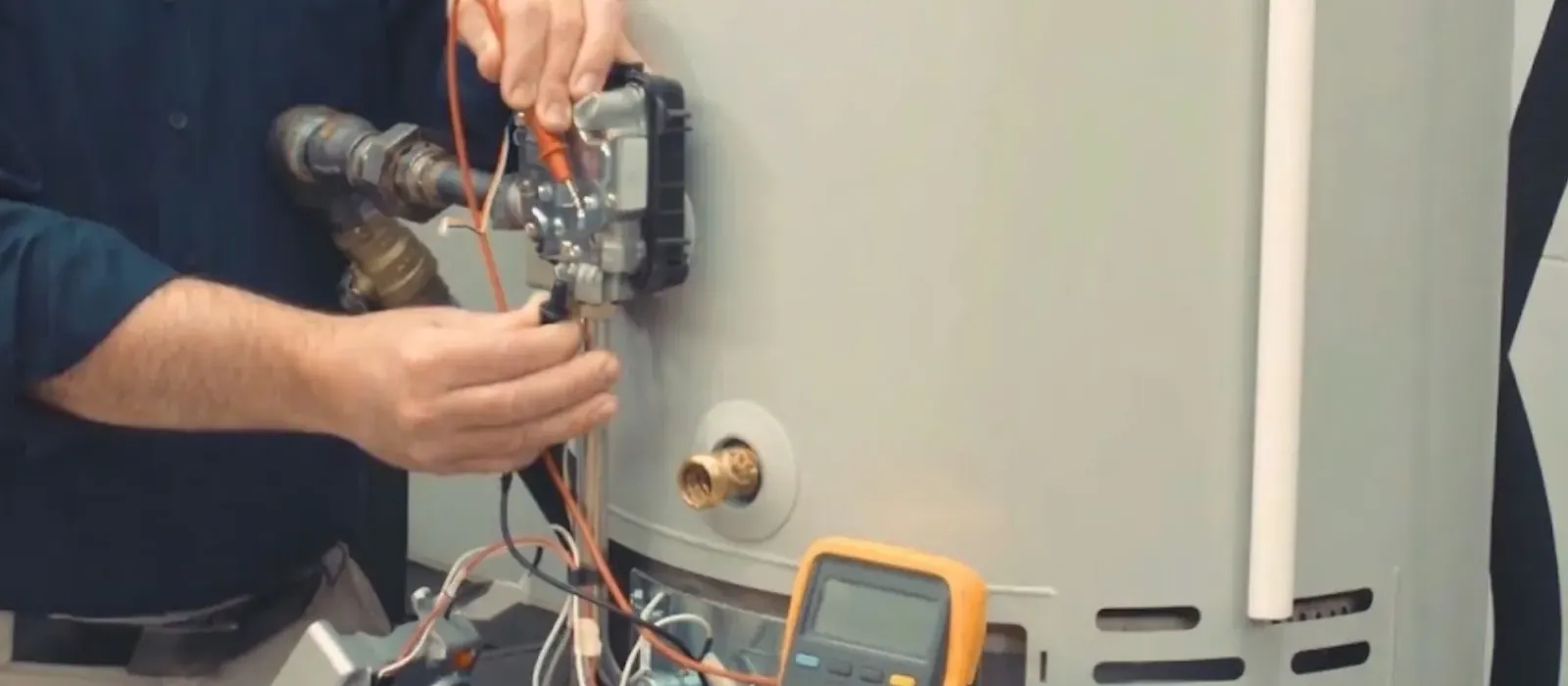
What to do first when the water heater leaks or dies
These steps limit damage until a plumber arrives. None of them needs tools beyond a flashlight and maybe a screwdriver.
- 1
Turn off the power or gas supply
For an electric tank, switch off its breaker at the panel. For a gas tank, turn the gas control knob to off or pilot. Never reach into standing water near an electric unit.
- 2
Close the cold water inlet
Find the shutoff valve on the pipe entering the top of the tank and close it: turn a round handle clockwise until it stops, or turn a lever a quarter turn across the pipe. This starves the leak of fresh supply.
- 3
Open one hot tap upstairs
A single open hot faucet lets pressure drop and keeps the tank from pushing more water out of a failed seam.
- 4
Move belongings and mop the edges
Lift boxes, rugs and cardboard off the floor. Towels around the base slow the spread toward flooring and drywall.
- 5
Leave the house if you smell gas
A rotten-egg smell, a hissing sound or a carbon monoxide alarm means gas work stops. Walk outside and call the gas utility or 911 first, then call us from the yard.
Once the water and power are off, call (561) 448-8545 and tell the dispatcher what the tank is doing. We will line up a licensed plumber and give you a clear price before any repair begins.
Leaking tank or leaking fitting: which one is it?
This single question decides whether you pay for a small repair or a new heater. Where the water comes from usually tells the story.
| Where the water shows | Likely cause | Repair or replace? |
|---|---|---|
| Dripping from the pipe at the top, wet around the nipples | Worn connection or failing inlet or outlet fitting | Repair. A new fitting or union is a short job. |
| Water from the temperature and pressure relief valve or its discharge pipe | Valve wear, or pressure and heat building inside the tank | Usually repair after the cause is found. |
| Puddle under a dripping drain valve | Loose or cracked drain valve | Repair. The valve is a replaceable part. |
| Water seeping from the bottom jacket or the base seam | Corroded steel tank wall or failed liner | Replace. A tank that leaks through its wall cannot be patched. See water heater replacement. |
| Water around the base only when a tap runs | Condensation, or a leaking line nearby | Check lines first. A leak detection visit may be cheaper than guessing. |
Sediment and rust-colored water at the bottom of an old tank point toward the corroded-wall row. If you cannot tell, call and describe it, and we will say which way it leans before a truck rolls.
No hot water, lukewarm water or strange noises
A heater that is not leaking can still be urgent when a full house needs showers. These are common faults.
Completely cold
On electric units this is often a tripped breaker, a failed upper heating element or a tripped high-limit reset. On gas units it is commonly a pilot that will not stay lit or a bad thermocouple.
Warm, then fades fast
A broken lower element or a dip tube that has worn through lets cold water mix with hot at the outlet. The tank holds heat, but you never get it.
Popping or rumbling
Sediment baked onto the bottom steam-bubbles through the water. It wastes energy and stresses the tank, and flushing may cure early cases.
Rust-tinged hot water
Rust only in hot taps usually means the tank interior or the anode rod is finished. Cold taps running rusty point at the house piping instead.
Tank leaking or no hot water?
Cold shower or wet floor? A licensed plumber can take the call.
What you can check before the plumber arrives
A few checks cost nothing and sometimes end the call. Others should never be attempted at home.
Safe to check yourself
- The breaker or fuse feeding an electric heater
- Whether the gas control is set to pilot or on
- The thermostat dial for an accidental low setting
- Whether the cold inlet valve is fully open
Leave to a licensed plumber
- Opening the heating element access panels
- Replacing a relief valve or any gas component
- Diagnosing a gas smell or soot around the burner
- Draining a tank that is already leaking from the wall
Gas appliances and the lines feeding them fall inside a plumbing contractor's legal scope in Florida, which is one more reason to hand this part to a licensed pro.
Village flushing advice, and why it matters here
The Village of Wellington's own guidance tells residents to drain a water heater tank per the manufacturer, usually once a year, and says tanks generally last a 6 to 15 year lifespan. It also notes that hot water can dissolve metals and sediment, so use cold water for drinking and cooking.
Tanks in homes that are decades old are usually replacements, so check the date on the data label to see how old yours is. If an older tank has never been flushed, sediment may already be packed in the bottom, and a hard drain can stress it, so have a plumber look before you open the drain valve.
What a water heater repair costs and why it varies
A part swap and a gas valve diagnosis can sit very far apart on the invoice. We give you the number only after a technician has seen the unit.
Insurance usually treats sudden bursts as covered and slow wear leaks as not, so read your policy and keep photos. A plumber can write up what failed.
When a repair stops making sense
If the tank wall is leaking, the unit is well past the middle of that village lifespan range, or the repair quote approaches half the price of a new heater, replacement usually wins. We lay out both numbers side by side so you decide with facts.
A heater in a garage or near a slab drain can hide slow leaks that stain concrete. If the floor stays damp after the tank is fixed, leak detection can find the real source.
Questions homeowners ask
Yes. The line at (561) 448-8545 is open 24 hours every day, and a dispatcher answers. Night and weekend water heater emergencies get the same licensed plumbers as daytime calls, and we give you a clear price before work starts.
Not if the leak comes from the tank body. Steel corrodes through from the inside and cannot be patched. Leaks from fittings, valves and supply connections are repairable.
Yes. Electric units usually need elements or thermostats. Gas units add the pilot, thermocouple, gas valve and venting. Anything touching gas stays with licensed plumbers.
Leave the building right away, do not flip switches, and call the gas utility or 911 from outside. We can follow up once it has been cleared.
Yes. Our crews also work in the neighboring village, and the page for Royal Palm Beach service lists the ZIP codes we cover there.
Look at tank age, the cost of the fix and whether the tank itself leaks. Our water heater replacement page lays out the rules we use.
Still have a question? Call (561) 448-8545