What to do first when you suspect an active leak
Five minutes of checking before the plumber arrives saves time on site and tells us where to start.
- 1
Stop the obvious water
If water is dripping or pooling, close the main shutoff valve, usually near the front hose bib or inside the garage on the wall closest to the street. Turn a round handle clockwise until it stops, or turn a lever a quarter turn across the pipe.
- 2
Run the meter test
Turn off every tap, the ice maker and the washing machine. Open the meter lid and look at the small leak dial. If it creeps with everything off, water is escaping somewhere.
- 3
Check the toilets
A few drops of food coloring in each tank, then wait 15 minutes without flushing. Color in the bowl means a leaking flapper, a common and cheap cause of a moving meter.
- 4
Call and describe the symptom
Tell the dispatcher what moved, what is wet and where. That decides which locating tools ride on the truck.
Do not drill or cut into drywall yourself. Opening the wrong spot spreads moisture and still misses the pipe.
Meter still running with every tap off
This is the cleanest sign of a leak, because the meter does not guess. When the dial moves with no fixture in use, water is leaving your plumbing somewhere between the meter and a fixture. The only question is where.
We start by splitting the property into zones, one test at a time. First close the house main and watch the meter. If it still moves, the leak is on the buried line between the meter and the house. If it stops, the leak is inside the house, and closing the water heater shutoff narrows it further.
Then run a separate test: close the irrigation supply and watch the meter again. An irrigation tie-in is usually upstream of the house main, so a meter that slows or stops here points to the sprinklers.
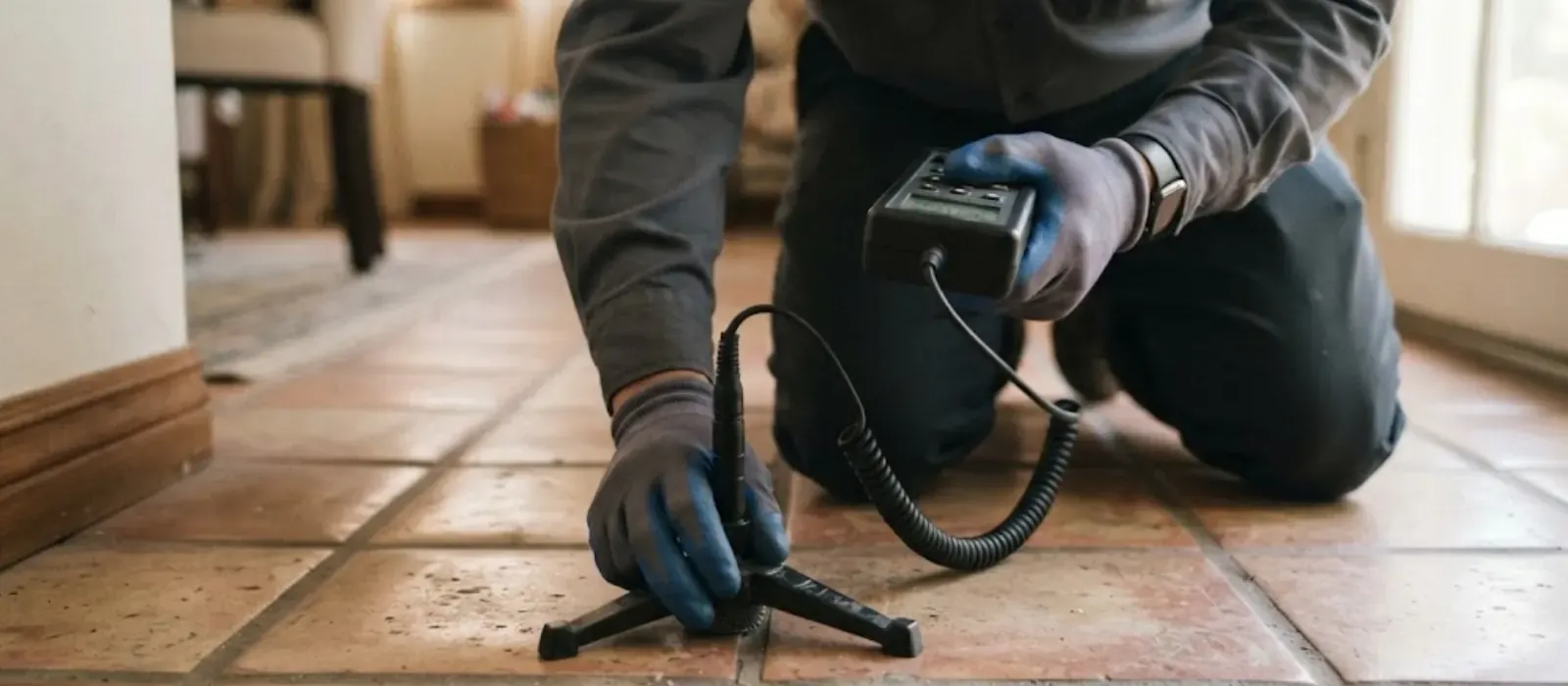
Once the zone is known, we narrow it with pressure testing and acoustic listening. A pinhole under pressure hisses, and sensitive microphones pick that up through flooring.
A high water bill with no change in habits
The Village of Wellington's own billing guidance says leaky fixtures and irrigation are the most common reasons for high usage. That matches what plumbers see: a toilet flapper that no longer seals, a sprinkler zone stuck open, a hose bib dripping behind a shrub. None of these look dramatic, and all of them run all night.
The village has a rule about sewer charges when monthly usage passes 15,000 gallons in a billing cycle, but treat it as a footnote, not a plan. Ask Wellington Utilities customer service how it applies to your account, and fix the leak so the next bill is the one you expected.
Meter moving and nobody home?
Dial (561) 448-8545 and give the dispatcher your meter reading.
A wet ceiling or damp wall
A brown stain on a ceiling usually sits below the real problem, not on top of it. Water follows joists and pipe runs before it shows, so the source can be several feet from the spot. A two-story home adds a bathroom, a supply line or an air handler drain pan to the suspect list.
If the ceiling is bulging, do not poke it with the lights on. Stay clear, place a bucket, switch the circuit off at the breaker, and call. A saturated drywall panel holds a lot of weight.
Leaks in walls and floors you cannot see into
Supply and drain lines also run through garage walls, closets and the chase beside the water heater, where a slow drip can go unseen for weeks. Soaked and sagging insulation, a musty smell in a closet or a floor that feels soft near a bathroom are the usual tells.
Many South Florida homes sit on concrete slabs, so the same symptoms can mean a line inside or under the slab. That is its own job, covered on our slab leak repair page.
Buried line leaks between the meter and the house
A leak in the underground line often shows up as a patch of lawn that stays green and spongy in dry weather, a puddle with no rain, or low pressure at every tap. Ask your utility where its responsibility ends before you plan any digging. We trace it by pressurizing the line and listening along its route, so the trench stays short.
When the line itself is failing, the fix is on the water line repair page: spot repair, a new section or a full replacement, and we explain which is which before work starts.
Irrigation leaks that hide in the yard
Sprinklers run on a timer, so a broken head or a cracked lateral can empty a tank of water before anyone notices. Look for soggy strips, geysers at the head, or zones that stay wet long after the cycle ends.
A valve that sticks open runs all day and pushes the meter at a steady rate, which is why we close the irrigation supply first during a meter test.
Which symptom points to which kind of leak
Use this as a starting guide. A technician confirms it with instruments.
| What you notice | Likely area | First check | Usual next step |
|---|---|---|---|
| Meter moves with everything off | Anywhere on the property | Toilet dye test and zone shutoffs | Locate with pressure test and listening gear |
| Meter stops when irrigation is closed | Sprinkler zone or valve | Walk each zone while it runs | Repair head, lateral or valve |
| Stain on a ceiling or wall | Supply, drain or drain pan above | Switch off power, place a bucket | Moisture mapping, then opening the source |
| Warm spot on a floor | Hot line in or under slab | Run hot water, feel the floor | See slab leak repair |
| Soggy lawn, low pressure | Buried line | Check the meter lid for water | Trace and repair the line |
Pool, spa, commercial and meter-box leaks
Pool and spa leaks are mostly a different problem from a house leak. The equipment pad has plumbing we can pressure test, but a crack in a shell or a liner needs a pool specialist. If your auto-fill line is the one leaking, we can find that.
For shops, restaurants and offices, a leak often hides above a drop ceiling or inside a wall shared with a neighbor. Our commercial plumbing team handles those jobs on a schedule that fits the business.
A wet meter box is a short one. If water stands in it, photograph it and call. Ask your utility where its responsibility ends before any digging starts.
Meter replacement season and your leak test
The Village of Wellington began a village-wide water meter replacement program in 2026, run by a contractor and expected to take 12 to 18 months. Service is interrupted for about 15 to 30 minutes, and the village suggests running the lines for 2 to 3 minutes afterward.
That has two practical effects. First, after a swap, flush your taps so trapped air and debris clear, and watch for drips at fixtures. Second, if your reading looks odd afterward, take a photo of the new meter face and compare it before you assume a leak. Ask Wellington Utilities if the numbers still look wrong.
Finding a leak does not require opening walls first. Once the leak is found, the repair falls under the Florida Building Code, Plumbing volume, which is based on the International Plumbing Code (IPC), and a pressure test is the usual way to confirm a line is sound.
What you can check yourself and what needs a licensed plumber
Homeowner checks narrow the search. They rarely finish it.
Quick checks at home
- Read the meter with all water off
- Toilet dye test in every tank
- Look under sinks for damp cabinets
- Walk irrigation zones and watch the heads
- Compare the last three bills
Work for a licensed plumber
- Pressure testing the supply lines
- Acoustic and thermal leak location
- Tracing buried or slab lines
- Opening walls or floors at the exact spot
- Repair, permit questions and a written price
The Village of Wellington's permit application says a separate permit must be secured for plumbing, so ask the Building Division what your job needs.
While you wait for the technician
Small steps that protect the house and make the visit faster.
Clear access
Move furniture away from the wet wall and clear the path to the meter, the main valve and the water heater.
Keep power safe
If water reached outlets or the panel, leave those circuits off and do not stand in standing water.
Note the numbers
Write down the meter reading and the time. A second reading when we arrive shows the leak rate.
What decides the cost of finding and fixing a leak
Finding a leak and repairing it are two different jobs, and the price follows the work. We give you a clear price before work starts, so no surprises come after the meter test.
Insurance usually responds to sudden, accidental water damage. Gradual leaks and wear are often excluded, and policies differ, so read yours or call your agent. A written leak report helps either way.
Questions homeowners ask
Yes. Our line is open 24 hours every day, and a dispatcher takes your call at any hour. Same-day appointments are offered when available, and after-hours calls get the same licensed plumbers.
Shut off the main valve while you wait if water is spreading.
Close the house main valve and watch the meter. If it still moves, the leak is on the buried line between the meter and the house. If it stops, the leak is inside the house. A meter that slows only when you close the irrigation supply points to the sprinkler system.
A slab leak is one kind of hidden leak, in a line inside or beneath the concrete. It needs different tools, covered on our slab leak repair page.
Ask Wellington Utilities to confirm the reading, especially if the meter was recently replaced. Then run the toilet dye test, since silent flapper leaks are common and can move in small bursts.
Yes. We serve homes and businesses in the village just northeast of Wellington. See our Royal Palm Beach emergency plumbing page for details.
Some policies pay for sudden damage and the access needed to find it. Others exclude gradual leaks. Call your insurer before approving repairs.
Still have a question? Call (561) 448-8545