Flooding or sewage backup at your business: what to do first
Start by finding the shutoff. Most commercial spaces have a valve near the restroom core, a suite shutoff, or a main near the meter. Close the closest one. Do not touch equipment standing in water. If the panel is dry and reachable, switch off power to the wet area at the breaker, or leave it to the electric utility or an electrician.
Next, protect what is hardest to replace: inventory, paperwork, electronics. If sewage is coming up through floor drains, close the area and keep staff and customers out. Raw sewage is a health hazard, and food businesses may need to close until the area is cleaned and the line cleared. Call us, then tell your landlord or property manager.
Commercial plumbing problems we handle
Burst or leaking pipes
Split supply lines, failed fittings and corroded connections above ceilings or behind walls.
Restroom stoppages
Backed-up toilets, urinals and floor drains, including repeat clogs that point to a deeper blockage.
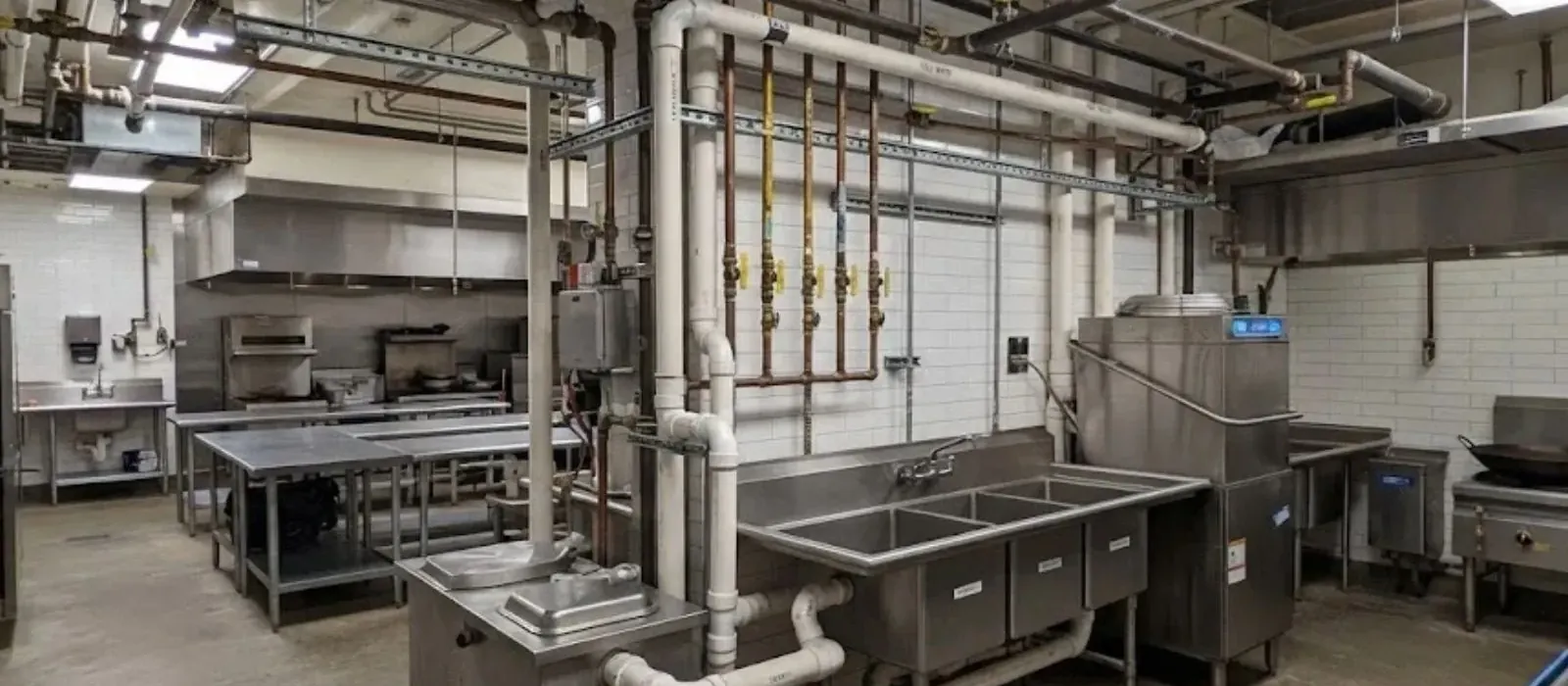
Kitchen and grease lines
Slow floor sinks, prep sink backups and drains narrowed by grease. A hydro jetting pass often clears what a cable leaves behind.
Water heater failures
No hot water for dishwashing or handwashing is a code and service problem. We repair or replace tank units.
Fixture repair and replacement
Flush valves, commercial faucets, hand sinks and mop sinks that leak or run constantly.
Residential versus commercial plumbing
The tools are familiar. The stakes and the logistics are different.
A typical home call
- One owner makes every decision
- One or two bathrooms and a kitchen
- Work can often wait until morning
- Water use is moderate and steady
A typical business call
- Owner, tenant and landlord may all need to approve work
- Larger pipe, more fixtures, longer runs
- Downtime costs money, so after-hours repair matters
- Heavy use, grease, and inspected equipment like backflow devices
Tell the dispatcher who owns the building and who can sign off, and the visit goes faster.
Business plumbing down?
Shop, suite or kitchen losing water? Call now and describe the space.
Commercial leak detection: what we can and cannot promise
A hidden leak in a business shows up as a water bill that stays high, damp ceiling tiles, a musty smell or low pressure in one suite. We trace these with pressure checks, isolation of branches, listening equipment and, where needed, opening a small section of wall or ceiling to confirm the source.
Large buildings take more time. A leak under a slab, between tenant spaces, or in a shared riser may require coordination with the landlord and sometimes with other trades. We will tell you honestly what we find, what is still unknown, and what the next step would be, rather than guessing. Our leak detection page covers the methods in more detail.
Backflow testing and prevention
A backflow preventer keeps dirty water from flowing backward into the clean supply. Businesses with irrigation, fire lines, boilers, car washes or commercial kitchens often have one.
The Village of Wellington's Cross Connection Program requires backflow prevention devices to be tested annually, and the village building division has a backflow permit packet. Florida Administrative Code 62-555.360 also prohibits cross-connections without proper backflow protection. A device that has not been tested, or that leaks from its relief port, is a compliance problem you should fix before it fails an inspection. Call us to arrange testing and to talk through repair or replacement.
Licenses, tax receipts and the Cross Connection Program
A business tax receipt is not a plumbing license. Before anyone opens a wall in your space, ask for the contractor's license and verify it with the Florida Department of Business and Professional Regulation. Under Florida law, unlicensed contracting is a first-degree misdemeanor for a first offense, and a contract with an unlicensed contractor is unenforceable by that contractor.
The Village of Wellington's permit application says a separate permit must be secured for plumbing, so ask the Building Division what your job needs. Because backflow devices fall under the annual Cross Connection Program, keep your test records in one file and tell us when the last test was done.
For a commercial job, the Florida Building Code, Plumbing volume, is the reference the building division works from, and it reviews each project on its own facts.
Who handles what in a leased space
| Problem | Usually first call | Notes |
|---|---|---|
| Leak inside your suite, from your fixture | Tenant calls the plumber | Check your lease for repair approval limits. |
| Leak in a wall shared with another tenant | Landlord or property manager | Call us if it is urgent, then notify the manager. |
| Water main or service line leak | Landlord, with the water utility | Check your water bill to see which utility serves the property. |
| Backflow device test | Property owner or tenant per lease | Annual testing is required by the village program. |
Leases differ, so read yours or ask the property manager before authorizing major repair work.
What shapes a commercial plumbing quote
Commercial jobs vary more than home repairs, so a price comes only after the problem has been seen. You hear a clear price before work begins.
Business property insurance may cover sudden water damage, while gradual leaks and wear often are not covered. Check your policy and keep photos.
After-hours help for businesses
Restaurants close at midnight and discover a backed-up line at 1 a.m. Offices find a ceiling stain on Monday morning. We answer all night, and same-day appointments are offered when available.
If the stoppage reaches the street connection, our sewer line cleaning service handles the main line. Businesses in Royal Palm Beach can reach the same line.
Questions homeowners ask
Yes. The line is open 24 hours a day, every day. Same-day appointments are offered when available, and the price is given before work starts.
Yes, and we can talk through repair or replacement if a device fails. The village requires annual testing under its Cross Connection Program.
Often, but larger buildings can take more time and coordination. We explain what we find and what remains uncertain before suggesting next steps.
It depends on your lease. For urgent work to stop damage, call us and notify your landlord at once. For larger repairs, get approval first.
Yes. We clear grease-narrowed drains and can recommend hydro jetting when cabling will not hold.
We repair and replace tank water heaters for businesses. Permit rules vary by job, so ask the Village Building Division whether yours needs one.
Still have a question? Call (561) 448-8545