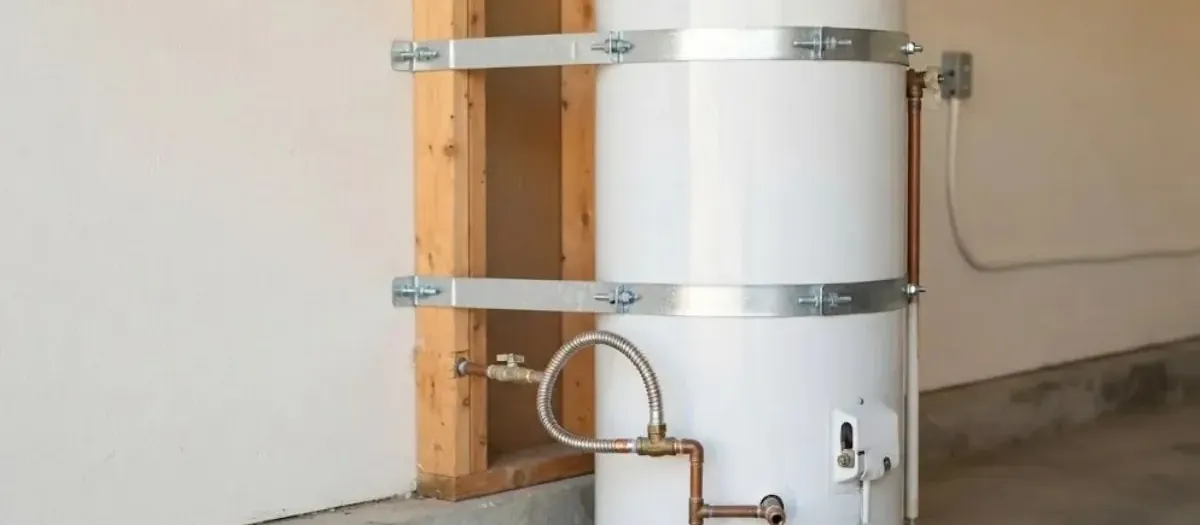
Tank failed and no hot water tonight: what to do while you wait
A dead heater at 10 p.m. is stressful, but three quick moves protect the house until the crew gets there.
Stop the water
Close the cold shutoff above the tank. If the valve will not turn, close the main shutoff where the line enters the house.
Cut power or gas
Flip the breaker for an electric unit. For gas, turn the control to off. If you smell gas or a CO alarm sounds, leave the building and call the gas utility or 911 before anything else.
Dry the area and plan for a cold night
Pull wet items off the floor and run towels along the base. A kettle or stove pot covers dishes and a quick wash until the new heater is in.
When should a water heater be replaced instead of repaired?
Age is only one input. This table weighs the signs we check on site, so you can see why we recommend one path or the other.
| What we find | What it means | Our usual advice |
|---|---|---|
| Water coming through the tank wall or base | The steel has corroded through | Replace. No patch holds. |
| Tank is in the upper part of the village's 6 to 15 year lifespan range | Parts are tired and the next failure is close | Replace if any repair is above a small part. |
| Rust-colored hot water and a hollow rumble | Heavy sediment, a spent anode rod, a worn liner | Replace on older tanks. Flush and test younger ones. |
| One failed element, thermostat or relief valve | A single wearing part | Repair, if the tank is sound. See water heater repair. |
| Repeated service calls in one season | System-wide decline | Replace. Chasing parts costs more than the heater. |
In homes that are decades old, the original tank has usually been replaced at least once. A second or third replacement is the normal rhythm, not a sign something is wrong with the house.
Questions that shape your replacement
The dispatcher or technician will ask for these. Having answers ready shortens the visit.
- Fuel type. Electric, natural gas or propane. Switching fuels is possible but changes the work.
- Tank size. Read the capacity on the data label. Tank sizes follow household needs more than house size.
- Location. Garage, closet, attic or utility room. Tight spaces and attics affect time and access.
- Venting. Gas units need a clear flue path. Electric units do not.
- Household habits. Two showers running at once, a soaking tub, or a full house during the winter season all change what size makes sense.
If you are weighing a different type of unit, our tankless water heater page explains the trade-offs.
Need a new heater today?
No hot water tonight? Ask what a replacement involves.
How a replacement swap runs
- 1
Confirm the cause
The technician checks that the tank itself failed and not a nearby fitting, so you do not replace a heater that only needed a valve.
- 2
Agree on the price
You hear the figure for the new unit, parts and labor before any work begins.
- 3
Drain and disconnect
Power, gas and water are secured, the tank is emptied and the old lines are released.
- 4
Set and connect the new unit
The new heater is leveled, connected to water and power or gas, and filled before it is energized.
- 5
Test and haul away
We check for leaks, confirm hot water at the tap and take the old tank with us.
Permits and the new small-job rule
Permit rules vary by job, so ask the Village of Wellington Building Division whether your work needs one. Permits are processed electronically only.
Wellington's own page says the new small-job permit exemption that took effect on 1 July 2026 does not cover plumbing work. So do not assume a cheap swap is exempt, and verify any contractor's license with the state before you sign.
What drives the cost of a new water heater
Two houses with the same size tank can land on very different totals. Here is what moves the number.
Insurers often cover sudden bursts and the water damage they cause, but not the wear that retires a tank. Ask your carrier and keep your photos.
Replacement without a flood: warning signs worth acting on
A small puddle that dries and returns, a rusty trickle at the drain valve, or a tank that sweats rust streaks down its side all mean the lining is nearly gone. Replacing at that stage costs less than mopping up a full tank release, which holds dozens of gallons.
If the heater is not the only wet spot in your home, leak detection can sort out whether the supply lines are involved before the new unit goes in.
Questions homeowners ask
Yes. The line is open 24 hours every day. Night and weekend replacement emergencies are handled by licensed plumbers, and same-day appointments are offered when available.
Timing depends on fuel, venting and access, and a like-for-like swap is the simplest case. Fuel changes, venting fixes or attic installs take longer. The technician gives you a realistic window on site.
Yes. Tell us about your household. Moving to a larger tank, a heat pump unit or a tankless model is possible, though some changes need more work.
Rules vary by job, so check with the Village of Wellington Building Division. Wellington's page also says the new small-job exemption does not apply to plumbing.
Water leaking from the tank wall or base is a dead tank. A failed element or thermostat is a repair. Our water heater installation page covers what the new setup involves.
Yes. Disposal is part of the visit, so you are not left with a drained tank in the garage.
Yes. See the Royal Palm Beach coverage page for the ZIPs we serve there.
Still have a question? Call (561) 448-8545