What the village treatment does and does not tell you
Wellington Utilities draws from the surficial aquifer and treats the water with lime softening plus membrane filtration. The lime softening plant reduces hardness, but the village's annual water quality report does not list a hardness number. That means nobody can tell you your exact mineral level from a map.
The treatment mix is also changing, because the village is phasing out lime softening in favor of full membrane treatment. So test your tap, ask Wellington Utilities, and size any equipment to your own results rather than to a guess.
Which system fits which problem
People often buy a softener to fix a taste issue or a filter to fix scale. Matching the tool to the complaint avoids wasted money.
| What you notice | What may help | Notes |
|---|---|---|
| White crust on faucets, spots on glass, scale in kettles | Salt-based softener or a scale-control conditioner | Confirm with a tap test first |
| Chlorine or chloramine taste and smell | Carbon filter at the kitchen sink or whole home | Chloramine needs the right carbon media |
| Sediment or cloudy water | Sediment cartridge ahead of other filters | Often paired with carbon |
| Better drinking water at one sink only | Under-sink or reverse osmosis filter | Small footprint, low flow |
| Scale buildup inside a tankless water heater | Treatment before the unit plus regular flushing | Check the maker's terms |
A plumber can read the symptoms, but only a water test settles the numbers. We ask for test results before recommending equipment.
Water softener and whole-home filtration: how they work
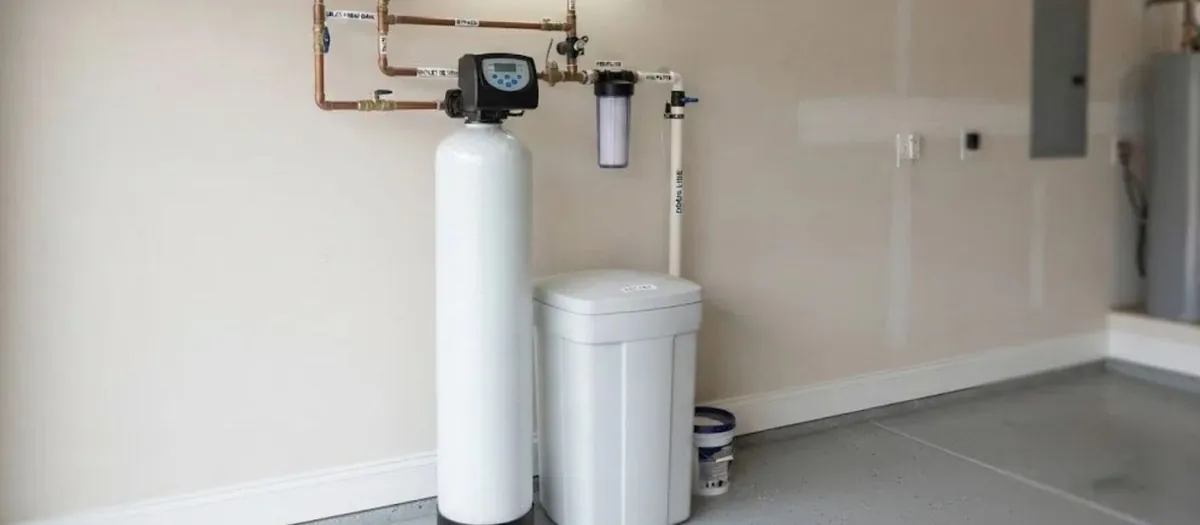
A salt-based softener swaps the minerals that cause scale for sodium or potassium inside a resin tank. The resin fills up over time, so the system backwashes and flushes with brine, drains the waste and starts over. Settings on the control head set when and how often that happens.
A whole-home filter works differently. It traps particles or adsorbs chemicals from all the water entering the house, using cartridges, sediment media or carbon. Each type needs a maintenance rhythm, whether that is replacing cartridges or backwashing a tank.
A conditioner, sometimes called a salt-free system, changes how minerals behave instead of removing them. It does not make water feel slick like a softener, which is a fair choice for some households and a letdown for others.
Not sure what you need?
Describe your spots, smell or scale and a plumber can narrow it down.
Softener or filter: a quick decision guide
Lean toward a softener when
- Scale and spotting are your main complaint
- A test confirms mineral content
- You accept adding salt and a drain connection
- You want protection for fixtures and appliances
Lean toward a filter when
- Taste and smell are the issue
- You want drinking water improved
- You prefer no salt or discharge
- A test shows sediment or chemicals
Many homes use both. A softener handles minerals, and a carbon filter handles taste. Ask which order they go in on your incoming line.
Chloramine, fish tanks and special needs
The village normally disinfects with chloramines and periodically switches to free chlorine on a temporary basis. Its own guidance says chloramine must be removed or neutralized for kidney dialysis, fish tanks and ponds, and businesses that need highly treated water. For dialysis, ask your care provider what water treatment they require. For fish tanks and ponds, use a dechlorinator rated for chloramine. A plumber can install point-of-entry or under-sink filters.
Ordinary carbon filters handle free chlorine more easily than chloramine, so tell us which one you want to remove.
How we install a treatment system
- 1
Test and talk
We review your test results and your complaint, then recommend a type and size.
- 2
Choose the spot
Most systems sit near the main line entering the house, with a drain and power nearby for softeners.
- 3
Plumb in a bypass
A bypass valve lets the system be taken out of service without shutting off water to the house.
- 4
Connect and program
Lines, drain and settings are set to match your test and household size.
- 5
Check pressure and leaks
We run the system and confirm there are no leaks and no pressure drop.
What a softener or filter install costs
Treatment equipment runs from a simple cartridge housing to a full multi-stage system. The real number comes after a technician sees the setup.
Insurance generally does not cover treatment equipment, but a sudden leak from it may be covered. Check your policy.
Repairing a softener or conditioner that stopped working
A softener that no longer softens is usually a salt bridge, a clogged injector, a stuck valve or exhausted resin. A control head that will not cycle, or a brine tank that overflows, are other common faults. Most are repairable, but an old resin bed may justify replacement.
Low water pressure after a new filter is a different problem. A clogged cartridge, an undersized housing or an aging pipe that may need repiping could be the cause, so check the filter first.
Questions homeowners ask
We do not guess. The village's lime softening plant reduces hardness, but its annual report does not list a number. Test your tap or ask Wellington Utilities, then decide.
Only with the right media. Standard carbon works better on free chlorine. Tell us your goal and we will match the filter.
Salt needs topping up regularly, and the resin and valve should be checked now and then. Your model's manual sets the schedule.
Usually yes. Give us the make and model and describe the fault so we can bring the right parts.
A properly sized unit should not. If pressure drops, a clogged cartridge, a stuck valve or a pipe issue may be the cause.
Rules vary by job. Ask the Village of Wellington Building Division. A licensed plumber can tell you what is usually asked.
Yes. See the Royal Palm Beach page for the ZIP codes. The line is open 24 hours.
Still have a question? Call (561) 448-8545