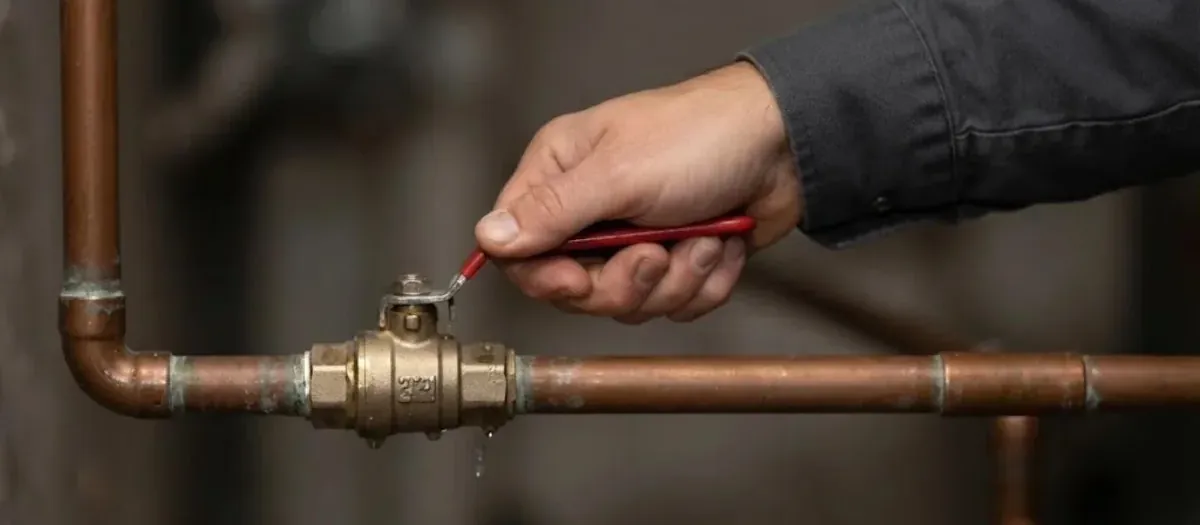
The valves in your house, from biggest to smallest
Every home has layers of shutoffs. The largest stops all water to the property, and the smallest stops one toilet or one faucet. When something leaks, the goal is to stop only what you must, so you keep water to the rest of the house.
Start with the biggest valve so you know how to stop everything in a hurry. Then learn the small ones, because they let you repair a faucet or swap a toilet supply line without losing the whole house.
Where each valve lives and what it controls
Use this as a scavenger hunt. Walk your house with a flashlight and tick each one off.
| Valve | Where to look | What it shuts off |
|---|---|---|
| Meter valve (utility side) | At the water meter, usually in a box near the street or property edge | Water to the whole property. It belongs to the utility, so ask before using it |
| Main house valve | Where the line enters the house, in the garage, near the water heater or on an outside wall | All water inside the house |
| Water heater cold inlet | On the cold pipe at the top of the tank | Water to the heater only |
| Toilet stop | On the wall or floor behind the toilet | That one toilet |
| Sink stops | Under the sink, one for hot and one for cold | That one faucet |
| Washer and dishwasher valves | Behind the washer, under the kitchen sink | That appliance only |
| Outdoor hose bib valve | Inside the house on the line to the spigot, if present | The outdoor tap |
Write the locations of your valves on a note stuck inside the cabinet under the kitchen sink. A guest or a house-sitter will thank you.
Gate valves vs ball valves
Two types are common, and they fail in different ways. Knowing which you have tells you how gently to treat it.
Gate valve (round wheel handle)
- Turns many times to close, like an outdoor hose spigot
- Common in older homes
- Internal parts can corrode or snap, so it may not seal even when turned all the way
- Never force a stuck wheel, since the stem can break
Ball valve (lever handle)
- Quarter turn from open to closed
- Handle in line with the pipe means open, across the pipe means closed
- Reliable and quick in an emergency
- Can still seize if it is never used
If your main is a gate valve that is old, stiff or leaking around the stem, ask a plumber about replacing it with a ball valve while the house is calm.
How to shut the water off in a leak
Work through this in order. Do not wait to be sure of the cause first, because stopping the water is always the right first move.
- 1
Close the nearest small valve
If the leak is at a toilet or sink, turn the fixture stop clockwise until it stops. This keeps the rest of the house running.
- 2
If it does not stop, close the main house valve
Turn the handle or wheel clockwise to the closed position. Open a low faucet to drain what is left in the pipes.
- 3
Turn off the water heater
If water may have drained from the heater, switch off its power or gas control so it does not run dry and overheat.
- 4
Move valuables and soak up water
Lift rugs and electronics, then use towels or a wet vacuum on the worst areas.
- 5
Call a plumber
Say what you shut off, where the water came from and whether it stopped. The number is (561) 448-8545.
Water will not stop?
Call (561) 448-8545 if the main valve will not hold.
Who handles a water main break, and who handles the leak inside
The village says to report a water main break to Wellington Customer Service at (561) 791-4010, or to the after-hours emergency line at (561) 791-4037. Report a main break to your utility. Indoor plumbing is ultimately the responsibility of homeowners. If your water bill comes from a different utility, call the number on that bill instead.
Meter locations vary by property, so check the front of your lot, often in a ground-level box near the street or along the property line. Your utility can tell you if you cannot find it. Before any repair outside the house, ask your utility which parts of the line it handles.
Exercise your valves twice a year
A valve that never moves can lock up with mineral buildup, which turns a simple shutoff into a repair. Ten minutes twice a year keeps them free.
- Turn each fixture stopClose it gently, then reopen it. If it will not budge or it weeps from the handle, mark it for replacement.
- Close and reopen the main house valveDo it slowly. Water should return to normal pressure when you open it all the way.
- Look for drips at the stemA slow drip under a handle means the packing or the valve is wearing out.
- Check hoses and supply linesWhile you are there, look at braided lines and flexible connectors for rust at the ends.
- Make sure the label is still visibleReplace any tag that has faded or fallen off.
When to call a plumber
Call if a valve will not close, drips from the stem or leaves the fixture wet even when shut. A failed under-sink stop is often a quick swap during faucet repair, and a plumber can replace it without taking the whole house offline.
If water is spraying, a pipe has cracked or the main valve will not stop the flow, If the main house valve will not stop the flow, call your utility's emergency line (check your bill for the number) and then call us. Our burst pipe repair team handles active leaks, and (561) 448-8545 is open 24 hours, every day.
For a street close to Royal Palm Beach, the service area page confirms whether a visit is possible.
Questions homeowners ask
Common spots are near the water heater, in the garage, on an exterior wall or where the supply line comes into the house. Follow the pipe from the outdoor hose bib or the water heater back toward the wall and you will often find it.
Clockwise to close and counterclockwise to open on a wheel-type valve. A lever handle closes when it sits across the pipe and opens when it lines up with the pipe.
Generally no. The meter and the valve on the utility side belong to the utility, so use your own main house valve first. If you think the line outside is the problem, call your utility.
Internal parts wear, minerals build up or the packing around the stem dries out. Gate valves in particular can stop closing completely after years of sitting untouched.
Call Wellington Customer Service at (561) 791-4010, or the after-hours emergency line at (561) 791-4037. If your bill is from Palm Beach County Utilities, use the number on that bill. Then call us for leaks inside the house.
A fixture stop with compression fittings is a common DIY job. The main house valve is different because the water has to be shut off upstream and a bad fitting floods the house. That job is better left to a licensed plumber.
Walk the front edge of your lot and look for a plastic or concrete box set in the ground, often near the street or a driveway apron. If you cannot find it, call your utility and ask. Do not open a box with your hands in case insects or wildlife are inside.
Still have a question? Call (561) 448-8545