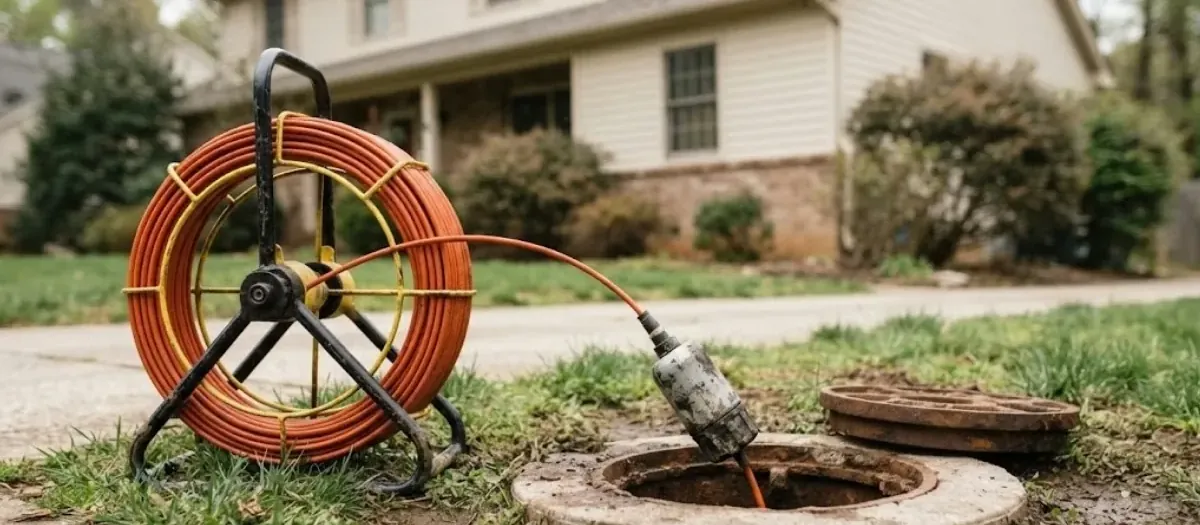
What a sewer camera shows that a cable never will
A drain cable feels for resistance. It cannot tell a root mass from a crushed joint, and it says nothing about the pipe after the plug is gone. A camera on a flexible rod travels the line with a light, a distance counter and sometimes a locator that marks the surface above a defect.
The result is a recorded view of the pipe from cleanout to connection. You get the depth and distance of any problem, so a repair quote can be written for a specific spot instead of a guess.
Findings and what each one usually means
A plumber reads the video in context. This table covers the patterns that show up most.
| What the camera shows | What it usually means | Likely next step |
|---|---|---|
| Roots at a joint | Water is escaping through a small gap | Cut the roots, then plan a joint repair |
| Standing water in a dip (a belly) | The pipe has settled and holds waste | Monitor or replace the sagging section |
| Cracks or a missing piece | The pipe wall has failed | Sewer line repair |
| Heavy grease or scale on the wall | Buildup is narrowing the pipe | Hydro jetting or cleaning |
| Clean, smooth pipe | No defect found in the line run | No repair needed, keep the video on file |
Why buyers in Wellington look at the sewer line
Nearly four in five Wellington homes were built between 1980 and 2009, so the buried pipe under a house you are buying has often spent decades in the ground. That makes a camera check before closing worth considering. The practical payoff is that a recorded inspection can be shown to the seller, so repair costs are negotiated up front, not discovered later.
Ask the inspector to run the line from the cleanout to where it leaves the property.
The report should note slope, joints, offsets, cracks and roots, with footage counts for each.
Buying a home or fighting repeat clogs?
Book the camera on (561) 448-8545 before closing day or the next dig.
How the inspection works
A typical visit follows these stages.
- 1
Locate the cleanout
The plumber finds the access point outside the home, or removes a toilet if none exists.
- 2
Feed the camera
The rod is pushed down the line while the monitor shows the live view.
- 3
Note defects
Each problem is marked by footage count, and a locator can mark the ground above it.
- 4
Review the recording
You hear the findings in plain terms and receive the video.
Good reasons to book an inspection
- You are buying a house and the sewer line has never been inspected.
- A drain has clogged more than once this year.
- There is a wet or sunken patch in the yard with no explanation.
- A tree stands near the sewer path and you suspect roots.
- You are about to put in a pool, a patio or a driveway over the line.
- A cleaning visit was done recently and you want to confirm the result.
Cleaning and inspecting often go together. See sewer line cleaning for how that part works, and note our line is open 24/7 when a backup cannot wait.
Camera inspection versus guessing
Some owners skip the camera and fix what they suspect.
Without a camera
- Repairs aimed at a guess
- Cleaning that may not address the cause
- No record for the seller or insurer
- Surprise findings in the middle of a dig
With a camera
- Defect located by distance and depth
- Repair plan matches the pipe
- Video record for negotiation and files
- A clean line confirmed when nothing is found
What goes into the price of an inspection
A basic inspection is far smaller than a repair, but the price still varies with the property. The technician explains it before the camera goes in.
Insurance rarely pays for an inspection by itself, though findings from sudden damage can support a claim. For home purchases, ask whether your agent can request the seller's repair credit.
Questions homeowners ask
Time depends on line length, access and how much buildup the camera meets, and the plumber can tell you more once the cleanout is found.
Yes. The recording is meant for you to keep, share with a seller or give to a repair crew.
It is a smart step for homes with older pipes. A camera look is a small step compared with discovering a failed line after closing.
It can show cracks and breaks in a sewer pipe, but supply leaks need leak detection, which uses different tools.
A blockage or a collapsed section may stop it. The distance is logged, and the plumber recommends cleaning or repair.
No. It identifies the problem. Cleaning or repair is a separate decision, and you approve the price first.
Yes. The Royal Palm Beach page lists the ZIP codes we serve.
Still have a question? Call (561) 448-8545