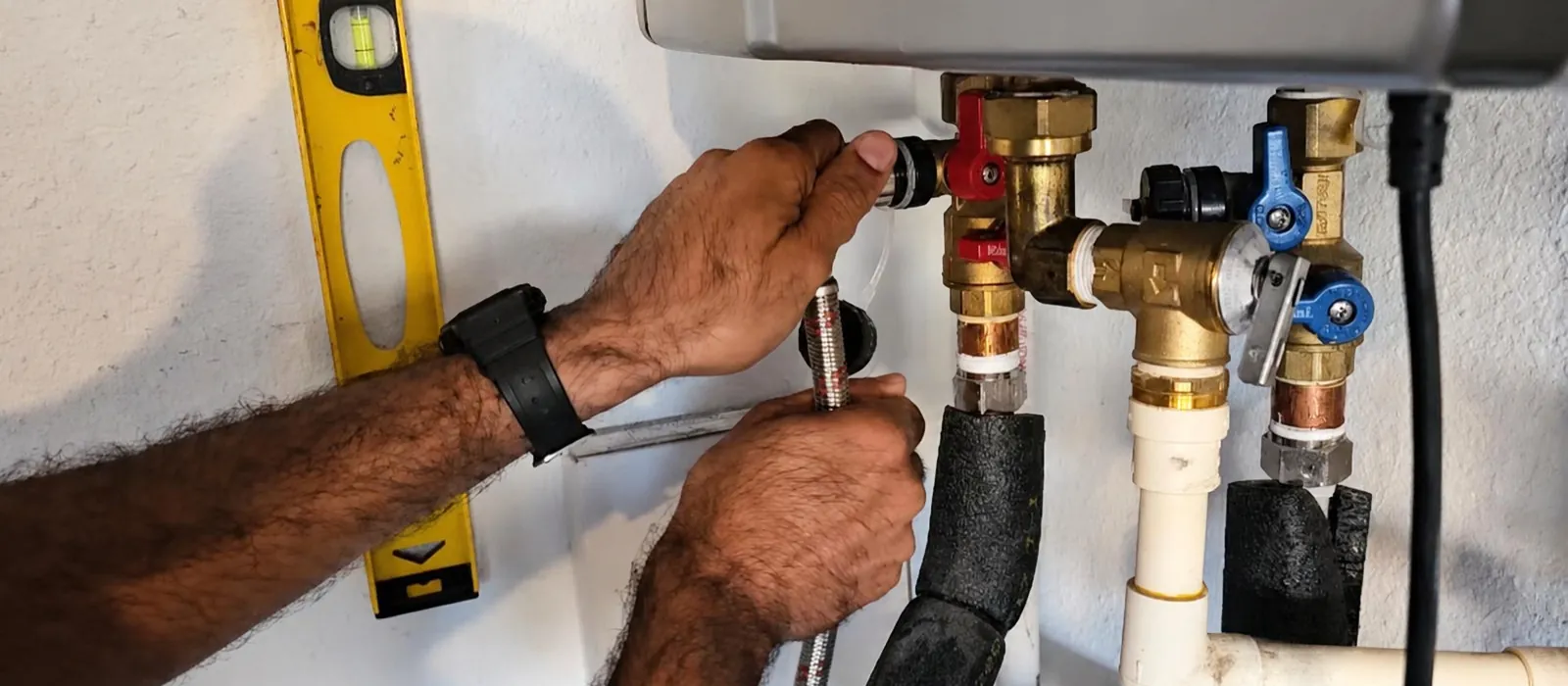
What happens inside the unit when you turn on a tap
The sequence takes only a few seconds, but each stage matters when something goes wrong.
- 1
A flow sensor notices moving water
When water starts to flow past a set minimum, a sensor tells the control board to fire up. A trickle that is too slow may never trigger it.
- 2
The burner or elements start
A gas unit lights a burner and runs a fan. An electric unit switches on heavy elements.
- 3
Water passes through the heat exchanger
Cold water moves through narrow metal passages wrapped around the heat source. This is the part that scale can choke.
- 4
The board keeps the outlet temperature steady
Sensors read the outlet temperature and adjust the flame or element power to match your setting.
- 5
Everything shuts off when you close the tap
Flow stops, the burner or elements shut down and the unit waits for the next call for hot water.
Gas or electric tankless: which one fits your house?
Capacity is the main difference. A tankless unit is rated in gallons per minute at a given temperature rise.
| Question | Natural gas or propane | Electric |
|---|---|---|
| How much hot water at once? | Can serve several fixtures when properly sized | Often limited to one or two fixtures per unit |
| What does the house need? | A larger gas line and a vent to the outdoors | Heavy electrical service, sometimes several large breakers |
| Venting | Required, usually sealed and made of special material | None |
| Install complexity | Gas, venting and condensate drain work | Panel capacity is often the hurdle |
| Best match | Larger households with a gas line already in place | Small homes, condos or a single point of use |
Before choosing, ask the plumber to check your panel for an electric unit or your gas line size for a gas unit. Many tankless jobs fail at the planning stage because the house cannot supply enough power or gas.
Flow rate and why a tankless unit can run out
A tankless heater does not run out of stored water. It runs out of capacity. If two showers and a dishwasher ask for more gallons per minute than the unit can heat, the water coming out runs lukewarm.
Add up your peak demand. A typical shower uses a couple of gallons per minute, a kitchen faucet a bit more, and a washer a few more. If those overlap, size the unit for the total or plan for two units. Low-flow fixtures help, but they also sometimes drop below the minimum flow a unit needs to fire.
Thinking about going tankless?
Call (561) 448-8545 to have your panel or gas line looked at before you buy.
What Wellington's water means for your tankless unit
Wellington Utilities uses chloramine as its normal disinfectant, and the village treats its water with lime softening and membrane filtration. The village's annual water quality report does not list a hardness number, so nobody can tell you your scale risk from the report alone. Customers billed by Palm Beach County Utilities should put the question to that utility.
Test your tap before choosing a descaling schedule. A simple test strip or a lab sample tells you far more than a guess does, and the answer decides whether you flush the unit once a year or more often.
A gas unit needs venting and a gas line sized to the maker's instructions, and an electric unit needs a circuit sized for its load, so confirm both before you order.
A practical descaling routine for a tankless heater
Scale is mineral that builds up in the heat exchanger and slows the flow of heat into the water. Flushing removes it.
- Test your tap waterUse a hardness test kit so you know whether scale is likely.
- Read your manualMost makers say how often to flush and which isolation valves to use.
- Install service valvesIsolation valves let a plumber flush the unit without cutting pipes.
- Flush with a mild acidA pump circulates white vinegar or a labeled descaling solution through the unit, then clean water rinses it.
- Clean the inlet screenA small filter at the cold inlet catches debris and clogs easily.
- Log the dateWrite the flush date near the unit so the next one does not slip.
Do you need a softener or filter with a tankless heater?
If your tap test shows a lot of minerals, a softener or scale filter protects the heat exchanger and cuts the number of flushes. Our water softener and filtration service covers testing and sizing a system for your home.
Chloramine adds one more point. It can shorten the life of some rubber seals and gaskets, so ask your plumber which parts in your unit are rated for it. The village also periodically switches temporarily to free chlorine as maintenance.
Recirculation: getting hot water faster
Because a tankless unit heats on demand, you still wait for the hot water to travel from the heater to the faucet. Long pipe runs mean a long wait. A recirculation pump keeps a loop of hot water moving so the tap is warm quickly.
Some units have a small built-in buffer tank for this. Others use a separate pump and a return line, or a pump that works under the sink. Recirculation uses extra energy and can shorten the life of the unit if it runs nonstop, so a timer or a button is better than leaving it on all day.
Tankless or tank: a fair look at each
Where a tankless unit wins
- Endless hot water as long as flow stays inside the rating.
- Frees closet or garage floor space because it mounts on a wall.
- No standing tank to rust through and flood the room.
- Longer typical service life when it is flushed on schedule.
Where a tank still makes sense
- Lower upfront cost and simpler installation.
- Works with a modest panel or gas line.
- Easy to replace with another tank.
- Handles brief demand spikes without needing large power or gas.
When to call a plumber about a tankless heater
Call a licensed plumber when you see an error code that returns after a reset, lukewarm water that never reaches temperature, or a drip at the unit. Installation, flushing and repair are covered on the tankless water heater service page.
If a unit stops working at night or leaks, shut off the water to it, turn off its power or gas and phone (561) 448-8545 at any hour. Towns such as Royal Palm Beach appear on the service area map.
Questions homeowners ask
Check the maker's manual first. Many say about once a year, but the right schedule depends on your water. Test your tap, and flush more often if scale shows up in the inlet screen.
Common causes are demand above the unit's rating, a clogged inlet screen, scale in the heat exchanger or a flow that is too low to fire the burner. A plumber can narrow it down in one visit.
Yes. A gas model still needs power for the fan, board and sensors. In a power outage it will not heat, so plan for that if outages worry you.
Often yes, if the unit is sized for the combined flow. Electric models are more likely to fall short. Add up the gallons per minute of the fixtures you use together.
Wellington Utilities uses chloramine and treats water with lime softening and membrane filtration, but its annual report gives no hardness number. Test your own tap, then set the descaling schedule from the result rather than guessing. If your bill is from Palm Beach County Utilities, ask them.
It can be, especially if you want to free floor space or avoid a tank leak. The savings depend on your usage and your fuel. A plumber can compare options for your house.
Still have a question? Call (561) 448-8545