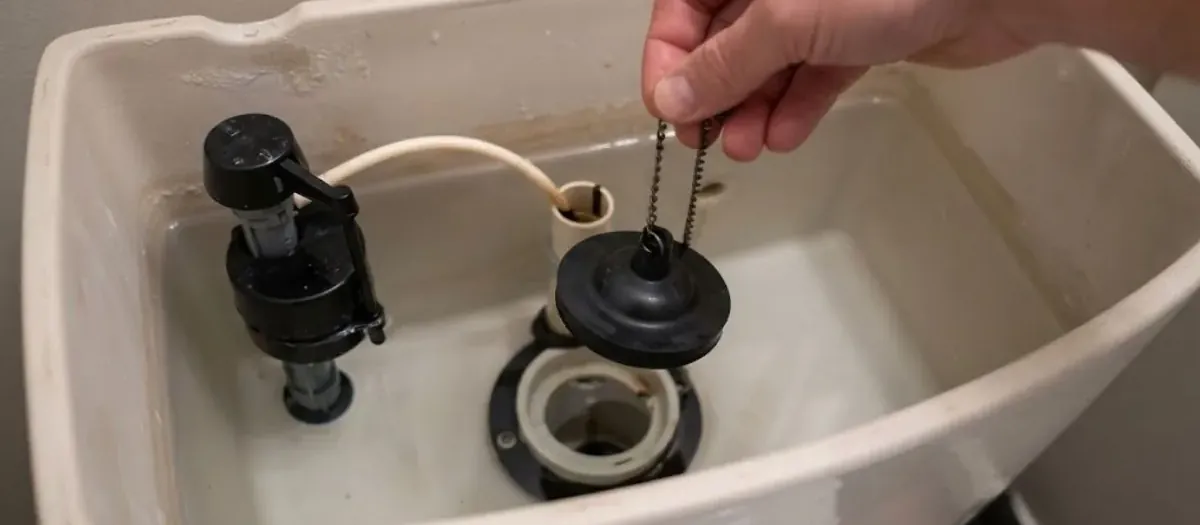
Clear it with a flange plunger
Use the right tool. A flat cup plunger made for sinks does not seal in a toilet bowl. A flange plunger has a soft rubber sleeve that folds out of the cup and fits the drain opening.
- 1
Stop the water
If the bowl is near the rim, lift the tank lid and push the flapper down, or close the supply valve behind the toilet. That stops more water from coming in.
- 2
Seat the plunger
Set the sleeve into the drain hole and press down slowly so the cup fills with water, not air. If the bowl is too low, add water from a bucket until the cup is covered.
- 3
Push and pull with a steady rhythm
Do five or six gentle strokes, then a sharp pull on the last one. The pull is what dislodges the blockage, and a fast, hard push can splash and drive it deeper.
- 4
Repeat three or four times
Check the bowl between rounds. When the water drains with a swirling gulp, the clog has moved. Flush once to test.
Hot water and dish soap: when it works
For a soft clog, mostly paper and waste, try this. Squirt a generous amount of liquid dish soap into the bowl, then pour in a bucket of hot tap water from waist height. Do not use boiling water, since it can crack porcelain.
Let it sit for ten to twenty minutes, then plunge again. The soap lubricates the pipe and the warm water softens paper. It will not touch a toy, a wipe or a clump of thick material, which need a tool to pull them free.
Which fix for which clog
Match the tool to the likely cause. The wrong tool wastes time and can scratch the bowl.
| What was flushed | What it looks like | Best first move | Next step |
|---|---|---|---|
| Too much toilet paper | Slow drain, bowl rises then falls | Plunger | Soap and hot water |
| Wipes or paper towels | Bowl fills and holds | Plunger, then closet auger | Plumber if it keeps returning |
| Small toy or hard object | Sudden stop, plunger has no effect | Closet auger | Pull the toilet if it will not come free |
| Feminine products | Sluggish flush, repeat clogs | Closet auger | Plumber to check the line |
| Nothing unusual | Other drains slow or gurgle too | Stop plunging | Call about the main line |
Water rising in the bowl?
Call (561) 448-8545 and describe what the bowl is doing.
Where Wellington's wastewater goes after you flush
The Village of Wellington treats the wastewater it collects to a reclaimed-water standard. Sewer systems are built for waste and toilet paper, not wipes, which tangle in pipes and pumps.
The practical payoff for you: a bin next to the toilet for wipes, cotton and floss keeps your own line clear and spares the system downstream. And if the toilet backs up while the tub, shower or sinks also run slow, that is a sign the main line is blocked, not the toilet, and a plunger will not fix it.
How a closet auger works
A closet auger is a short cable inside a rigid tube with a curved end that protects the porcelain. You set the curved end into the drain, crank the handle and push gently until you feel the cable bite into the clog. Then pull back slowly to bring the material out or break it up.
Keep your pressure light. If the tip meets firm resistance and the handle will not turn, stop, since a hard object can be wedged in the trap. Rinse the tool before storing it, and wear gloves.
What not to flush
This list prevents most toilet clogs on its own.
- Wipes of any kind.Labels that say flushable are about whether they fit in the pipe, not whether they break down in time.
- Paper towels and tissues.They are thicker than toilet paper and do not dissolve.
- Cotton swabs, balls and dental floss.They catch on rough spots and build into mats.
- Feminine products, diapers and condoms.These swell and tangle.
- Grease, cat litter and medication.They harden in the pipe or do not belong in the water supply.
When the clog is bigger than the toilet
If any of these show up, stop plunging and call. The problem is downstream.
Several drains slow at once
The toilet, the tub and the sink all drain badly after use. All of them share the main line.
Gurgling or bubbling
Running a sink makes the toilet bowl bubble. Air is being pushed backward by a blockage.
Sewage smell or wet floor drain
A backup at the lowest drain in the house is the main line speaking.
Repeated clogs after a fresh clear
If the same toilet clogs again within days, something deeper, like roots or a belly in the pipe, is catching the flow.
When to call a plumber for a toilet clog
Phone a plumber when the plunger and auger fail, the water keeps rising, or more than one fixture is backing up. If water is spilling over the bowl, close the supply valve behind the toilet and stop flushing.
A single stubborn toilet is a job for toilet repair. Backups at several fixtures call for sewer line cleaning. Phone (561) 448-8545 any hour. Neighbors across town in Royal Palm Beach can check the service area map to see if we cover their street.
Questions homeowners ask
Yes, if the water is hot from the tap and not boiling. Boiling water can crack the porcelain or damage the wax seal below the bowl.
Common causes are too much paper at once, a low-flow flush that is losing power, or a partial blockage in the trap or line. A plumber can check the flush and look past the trap.
They fit through the pipe, but they do not break down like paper. Village-served wastewater is treated to reclaimed-water standard, and wipes cause trouble in pipes and pumps. Throw them in the trash.
If only one toilet is slow and the other drains are fine, it is the toilet. If the toilet backs up when you run the tub or sink, or several drains are slow, the main line is blocked.
Yes. It has a rubber or vinyl sleeve over the bend to protect the porcelain. Go slowly and do not force the cable.
Close the supply valve behind the toilet, stop flushing and stop using other drains if they are slow too. Lay towels around the base and keep children and pets away.
Not at first. If it is only your house, call a plumber. If neighbors have backups too, call the utility.
Still have a question? Call (561) 448-8545