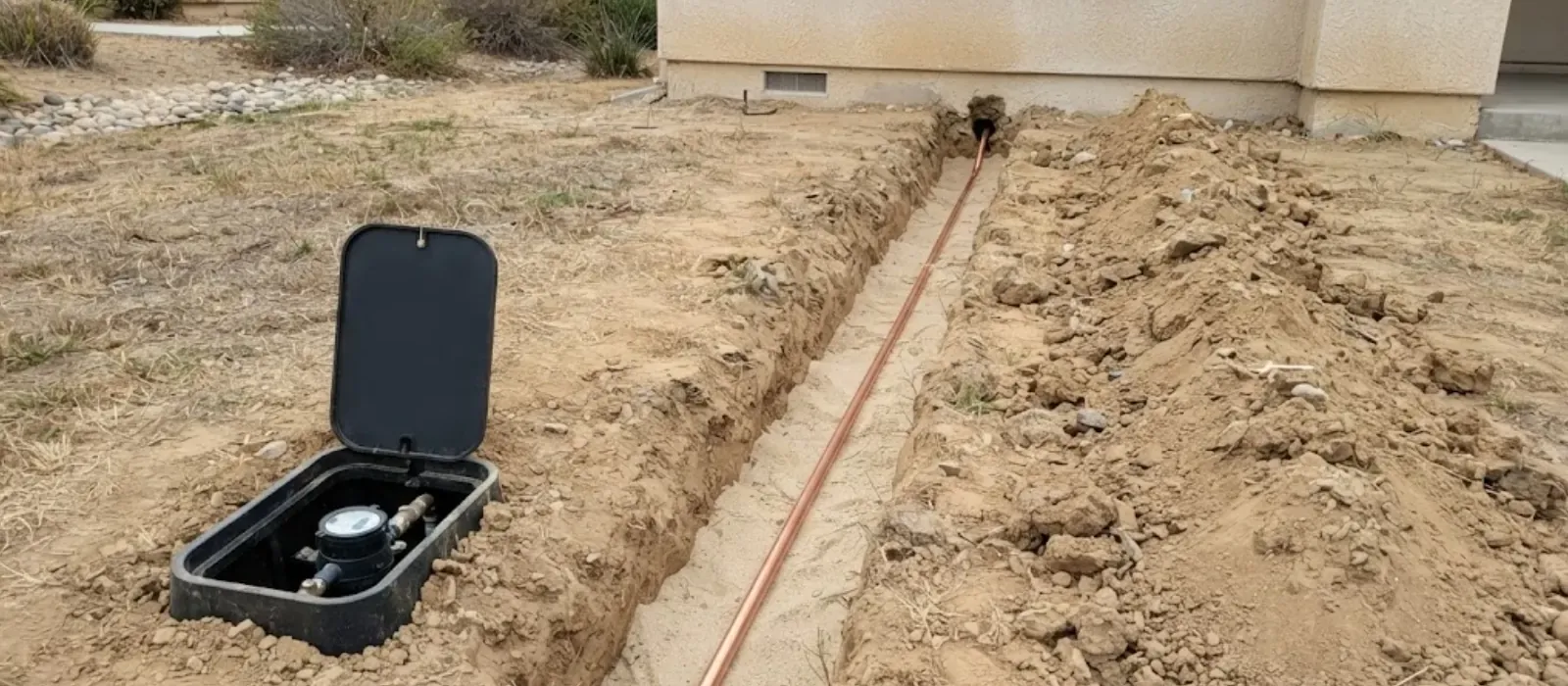
What low pressure really tells you
Pressure is the push behind the water, measured in pounds per square inch (psi). Many plumbers like to see somewhere around 50 to 60 psi at an outdoor hose bib, and most households notice trouble once it falls well below 40. Flow is a different thing: it is how much water actually comes out, and it can fall even when pressure looks fine on a gauge.
The most useful clue is where the problem shows up. A weak stream at one sink points to something small at that sink. Weak water at every tap points to something upstream, like the regulator, the main shutoff, the supply pipe or the utility main.
One fixture or the whole house: a quick sorting table
Spend two minutes running water at different places before you touch any tool. Match what you see to the closest row.
| What you notice | Most likely cause | First thing to check |
|---|---|---|
| One faucet is weak, others are fine | Clogged aerator or worn cartridge | Unscrew the aerator and look for grit |
| Hot is weak, cold is strong | Sediment in the water heater or a partly closed hot-side valve | Compare the hot and cold streams at two taps |
| Every fixture is weak, all the time | Main shutoff not fully open or a failing regulator | Check that the main valve handle is fully turned |
| Pressure fell slowly over months | Corroded or scaled supply lines | Look at exposed pipe for green crust, rust or white scale |
| Pressure dropped suddenly with a wet spot or hissing | A leak on the supply side | Watch the water meter with every fixture off |
| Weak at every tap for a short time, then back | Utility maintenance or a meter swap | Ask your water utility about work on your street |
If two rows seem to fit, start with the cheapest and easiest check, which is nearly always the aerator.
A 20-minute check you can do safely
None of these steps needs special skill, and none involves cutting a pipe. Stop and call a plumber if you find water where it should not be.
- 1
Test hot and cold separately
Run each side at the kitchen sink, then at a bathroom sink and the tub. Write down which taps are weak. A pattern tells you more than a single guess.
- 2
Clean the aerator
Unscrew the little screen at the tip of a weak faucet, tap out the debris and soak it in white vinegar for an hour. Rinse and screw it back on by hand. This fixes more weak sinks than any other step.
- 3
Check the shutoff valves
Find the main shutoff and the stop valves under the sink. A handle that sits at an angle instead of fully open will cut flow. Turn it slowly to the full open position and never force a stuck valve.
- 4
Read the pressure
Screw an inexpensive pressure gauge onto an outdoor hose bib, turn the spigot on and read the dial. Do it again late at night when neighbors use less water, because daytime demand can drag pressure down.
- 5
Test for a hidden leak
Turn off everything that uses water, then look at the meter. If the small leak indicator or the dial keeps moving, water is escaping somewhere you cannot see.
Pressure still low after the quick checks?
Call (561) 448-8545 if the meter still moves with every tap off.
The causes plumbers find most often inside the house
Once the quick checks are done, these are the usual suspects. Each one has a different fix and a different cost range, so naming the right one matters.
Clogged aerators and showerheads
Mineral flakes and bits of pipe scale collect in the fine screens. Soaking or replacing the part is cheap and fast.
Partly closed valves
A main valve that was bumped, a stop valve left half open after a repair or a failing gate valve can all choke flow to the whole house.
A failing pressure regulator
Many homes have a bell-shaped regulator near the main shutoff that holds pressure steady. When its internal spring or diaphragm weakens, pressure can sag or swing up and down.
Corroded or narrowed supply lines
Older galvanized steel closes in from the inside as rust builds up, and some copper and plastic systems develop leaks or restrictions. This is why pressure that slowly worsens over a long time often means pipe age.
Replacing a regulator is a short job for a licensed plumber. Pipe that has narrowed is a bigger decision, and it is the one place where repiping can solve the problem for good.
Wellington pressure: which utility serves you and the 2026 meter program
Not every address in Wellington gets water from the same utility. Wellington Utilities supplies water across its service area, but addresses east of State Road 7, such as Buena Vida, Olympia and VillageWalk, are served by Palm Beach County Utilities instead. Your water bill names the utility, so if pressure is low at every fixture and your house checks out, call that utility and ask about main-side pressure in your area.
The village also began a water meter replacement program in 2026, expected to run 12 to 18 months. Each swap interrupts service for about 15 to 30 minutes, and afterward the village suggests running taps for 2 to 3 minutes to clear the lines. Loosened grit can lodge in an aerator, so if one faucet turns weak right after a swap, clean that screen before assuming something bigger is wrong.
Fix it yourself or call a plumber
Some pressure problems are a Saturday morning job. Others involve pipe, valves with water behind them or a pressurized main, which is where a license matters.
Reasonable to try yourself
- Cleaning or replacing an aerator or showerhead
- Opening a handle that is only partly turned
- Reading pressure at a hose bib with a screw-on gauge
- Calling your utility to ask about work on your street
Better for a licensed plumber
- Replacing a pressure regulator or the main shutoff
- A meter that moves with every fixture off
- Weak hot water at every tap after a tank flush
- Rusty, green or scaled supply pipe
- Any job where you would have to cut into a pipe
When to call a plumber
Call if the checks above turn up nothing, if the pressure keeps changing from hour to hour or if you suspect a hidden leak. A moving meter with everything off is a strong sign, and a technician can locate the break with leak detection tools instead of opening walls at random.
If water pressure has been fading for a long time and the pipes in your attic, garage or under the slab are old, the honest answer may be repiping. A plumber can look at the material, explain what condition it is in and give you a clear price before work starts.
If you hear running water you cannot trace or see a wet spot spreading, shut off the main valve first and then call (561) 448-8545, which is open 24 hours, every day. Crews also cover the streets around Royal Palm Beach, and the service area page lists the rest.
Questions homeowners ask
Many homes run comfortably between about 50 and 60 psi, and a lot of fixtures are designed to work somewhere in the 40 to 80 psi band. Below roughly 40 you start to notice weak showers, and well above 80 can stress hoses and appliances.
Yes. Water that escapes before it reaches your taps takes pressure with it. Turn everything off and watch the meter, and if it still moves, a hidden leak is likely.
If only one fixture or one side of the house is weak, the cause is almost always yours. If every fixture is weak, neighbors are affected and your valves and regulator check out, ask the utility named on your bill about main-side pressure. Ask which parts of the line it handles.
Run a cold tap for 2 to 3 minutes, as the village suggests, then clean the aerators on any weak faucets, because loosened grit often lands there. If the whole house is still weak a day later, check that your main house valve is fully open, then call a plumber and tell them the meter was recently replaced.
Warning signs include pressure that rises and falls on its own, loud banging when you shut a tap, a pressure gauge reading far from normal or a relief valve dripping on the water heater. A plumber can test the regulator and replace it in a short visit.
Still have a question? Call (561) 448-8545