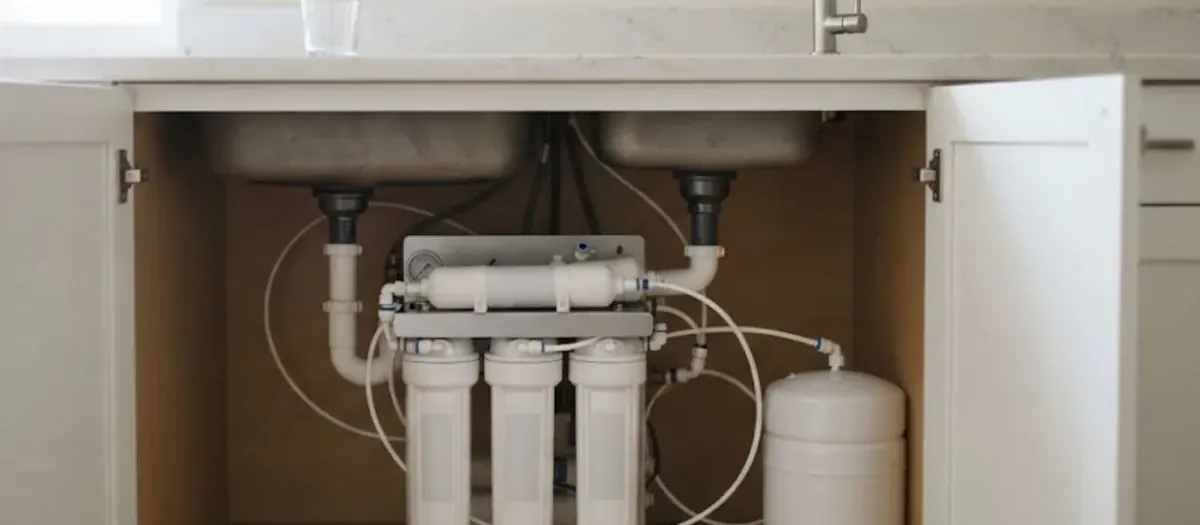
Why a business filters water at all
Homes drink the water that comes out of the tap. Businesses ask more from it. Ice machines, espresso machines, steamers and dishwashers run all day, and anything in the water can show up as cloudy ice, odd-tasting coffee, spots on glasses or scale inside a boiler.
Filtration is not one product. It is a short chain of stages, each aimed at a different problem, and the best choice is the smallest chain that solves your particular problem.
Filter types and what each one does
Most commercial systems combine two or three of these. The table shows the job of each stage.
| Stage | What it removes | Best for | Watch out for |
|---|---|---|---|
| Sediment filter | Sand, rust flakes and other particles | Protecting every later stage and valves | Clogs and drops flow if it is never changed |
| Carbon filter | Chlorine taste and odor, some organic compounds | Coffee, tea, fountain drinks, ice | Standard carbon is slow on chloramine, so ask about catalytic carbon |
| Catalytic carbon | Chloramine more effectively than standard carbon | Businesses on chloraminated water | Needs enough contact time and correct sizing |
| Reverse osmosis (RO) | Dissolved minerals and many other contaminants | Ice, espresso, bakeries, lab-style needs | Wastes some water and often needs a storage tank and remineralizing for coffee |
| Softener | Calcium and magnesium that cause scale | Water heaters, dishwashers, steamers | Does not filter particles or chloramine on its own |
A filter without a pre-filter often dies early. Sediment first, carbon second and membranes last is the usual order for a reason.
Wellington water treatment and why chloramine matters to a business
The village treats surficial aquifer water with lime softening and membranes, and it is phasing out lime softening for full membrane treatment, so the treatment mix is changing. Chloramines are the normal disinfectant, and the village says they must be removed or neutralized for kidney dialysis, fish tanks and ponds and businesses requiring highly treated water.
The village's annual water quality report does not list a hardness number, so test your own tap or ask Wellington Utilities before you size a softener. If you are east of State Road 7, your supplier may be Palm Beach County Utilities, so check the bill to see who to ask.
Need a filter plan for your business?
Call (561) 448-8545 with a list of your water-sensitive equipment.
Point-of-use filters vs a whole-building system
You do not always need to treat every drop. Where you put the filter changes both the cost and the result.
Point-of-use (under a machine or sink)
- Fits ice machines, coffee brewers and a single prep sink
- Easy to swap cartridges at the machine
- Treats only the water for that device
- Needs a separate filter for each machine
Whole-building (on the main line)
- Protects every fixture, heater and appliance
- Good when scale, sediment or chloramine affect many machines
- Needs space, a bypass and correct pipe sizing
- Installed by a licensed plumber
Many businesses end up with a hybrid: a sediment and carbon stage on the main line plus an RO unit at the ice or espresso machine.
How to pick and size a system
A plumber will ask these questions in about the same order. Having answers ready speeds up the visit and gives a more accurate price.
- 1
List the water-sensitive equipment
Write down every ice machine, espresso machine, steamer, dishwasher and water heater, and note the model if you can.
- 2
Check maker recommendations
Most commercial equipment lists the water quality it needs. Following it often protects the warranty.
- 3
Estimate peak flow
A system sized for average use will starve the kitchen at lunch. Think about the busiest hour and how many machines run together.
- 4
Test the water
A basic test of your own tap shows hardness and other numbers. Do not rely on a guess, because the utility does not publish hardness in its report.
- 5
Decide where the filter goes
The plumber will look for a spot near the main line with room for the housings, a bypass valve and access for filter changes.
Maintenance that keeps a filter system working
A neglected filter is worse than none, because it can clog, restrict flow and grow slime. Plan the upkeep before you buy.
- Change cartridges on scheduleSediment and carbon cartridges are replaced by date or by gallons used, whichever comes first.
- Log pressure dropGauges before and after the housings show when a cartridge is clogged.
- Sanitize at each changeHousings and lines should be cleaned when cartridges are swapped, especially on ice machines.
- Service RO membranesMembranes lose output over time. A drop in water produced or a rise in dissolved solids means it is time to replace.
- Keep recordsWrite down dates and cartridge types so staff know when the next change is due.
When to call a plumber
Call before you buy a system, not after. A licensed plumber can check pipe size, install a bypass and make sure the filter housings do not leak or restrict flow. Our water softener and filtration service covers the equipment side, and our commercial plumbing team handles the business setting, including after-hours work.
If your ice tastes off, your coffee has changed or equipment is scaling up, note which machine and what you noticed before you call (561) 448-8545, open 24 hours, every day. Businesses near Royal Palm Beach can check the service area page for coverage.
Questions homeowners ask
Most start with a sediment filter, then carbon to take out chlorine taste, and sometimes reverse osmosis for the cleanest ice or espresso. Check your machine's maker for the water quality it wants.
It removes some, but slowly. Catalytic carbon and enough contact time work better. A plumber can size the filter for your flow.
No. A softener swaps hardness minerals to reduce scale, while a filter removes particles, taste or chemicals. Many businesses use both.
It depends on the cartridge and your water use. Many are changed by a set date or a gallon count, and a pressure gauge on either side of the housing shows when one is clogged.
The village says chloramines must be removed or neutralized for kidney dialysis, fish tanks and ponds and businesses requiring highly treated water. If your work falls into one of those groups, ask your equipment maker how to remove chloramine.
Whether a filtration job needs a permit depends on the work, so the Village of Wellington Building Division is the place to ask.
Yes. A simple hardness strip or a lab test of your tap gives you real numbers. The village's annual report does not list hardness, so testing is the only way to know.
Yes, some. An RO system sends a portion of the incoming water to drain as it cleans. Ask about the ratio and whether a storage tank would reduce waste during busy hours.
Still have a question? Call (561) 448-8545